What Is Halal? Meaning, Food, Slaughter and Certification
Halal is an Arabic word meaning permitted or lawful in Islam. For food, it means anything Muslims may eat or drink. Plants, fish and most foods are halal by default. Meat is halal when it comes from a permitted animal slaughtered by the Islamic method with Allah's name, and nothing haram, such as pork or alcohol, has been added.
✅ HalalIn this guide14 sections
- Halal at a glance
- What does halal mean?
- The golden rule: most things are halal
- What makes food halal?
- Which animals are halal?
- What is halal meat? Zabiha slaughter explained
- Halal certification: who certifies, and what a logo means
- Halal vs kosher
- Halal beyond food
- How to check if a product is halal
- Find the answer for a specific food
- Final thoughts
- Frequently asked questions
- Related guides
Halal is an Arabic word meaning permitted or lawful. In Islam, it describes anything a Muslim is allowed to do, and in everyday English it’s used most often for food and drink. Its opposite is haram, meaning forbidden.
Here’s the part many people don’t realise: in Islamic law, food is halal by default. Fruit, vegetables, grains, milk, eggs and fish are all halal unless something haram is added. The questions come up mainly with meat, which has to come from a permitted animal slaughtered in the Islamic way, and with processed ingredients like gelatin, alcohol and some E-numbers.
This guide explains what halal means, what makes food and meat halal, how zabiha slaughter works, where scholars and certifiers disagree, who certifies halal food around the world, and how to check any product yourself.
Halal at a glance
| Question | Short answer |
|---|---|
| What does halal mean? | Permitted or lawful in Islam |
| What’s the opposite? | Haram (forbidden). See our guide to what is haram |
| Is most food halal? | Yes. Plants, grains, dairy, eggs and fish are halal by default |
| What makes meat halal? | A permitted animal, slaughtered by the Islamic method with Allah’s name, blood drained |
| What’s never halal? | Pork, blood, carrion, alcohol and other intoxicants, animals slaughtered in another name |
| Is halal only about food? | No. It covers earnings, business, finance, medicine and more |
| Who decides? | Allah and His Messenger, through the Quran and Sunnah, explained by scholars |
What does halal mean?
The Arabic root of halal, h-l-l, carries the idea of untying or releasing. Something halal is “released” from restriction: you’re free to do it. In the Quran, Allah tells all people:
“O humanity! Eat from what is lawful and good on the earth and do not follow Satan’s footsteps.” (Surah Al-Baqarah 2:168)
The word for “lawful” in that verse is halal, and “good” is tayyib. Muslims are asked for both.
Halal and tayyib: lawful and good
Tayyib means good, pure and wholesome. Scholars explain that food should be halal in its ruling and tayyib in its quality: clean, safe, not harmful, and produced without cruelty or cheating. That’s why Islamic slaughter rules include kindness to animals, and why halal certifiers also check hygiene. The Prophet (peace be upon him) said:
“Verily Allah has enjoined goodness to everything; so when you kill, kill in a good way and when you slaughter, slaughter in a good way.” (Sahih Muslim 1955)
In the same hadith, he told people to sharpen their blades and spare the animal suffering.
Where halal fits among the five rulings
Islamic law sorts every action into five categories:
- Obligatory (fard or wajib)
- Recommended (mustahabb)
- Permitted (mubah)
- Disliked (makruh)
- Forbidden (haram)
In everyday speech, “halal” covers the first four: anything that isn’t haram. We explain all five in detail in our guide to what is haram.
The golden rule: most things are halal
The most important principle in this whole subject is that permission is the default. The Prophet (peace be upon him) was asked about fat, cheese and furs, and he said:
“The lawful is what Allah made lawful in His Book, the unlawful is what Allah made unlawful in his Book, and what He was silent about; then it is among that for which He has pardoned.” (Jami at-Tirmidhi 1726)
Imam al-Suyuti, the Shafi’i jurist, records this as a legal maxim in al-Ashbah wa al-Naza’ir: the default ruling for things is permissibility. Sheikh Yusuf al-Qaradawi made it the first principle of his well-known book The Lawful and the Prohibited in Islam.
The principle works in both directions. Allah warns against inventing new prohibitions:
“O believers! Do not forbid the good things which Allah has made lawful for you, and do not transgress.” (Surah Al-Ma’idah 5:87)
And He asks, “Who has forbidden the adornments and lawful provisions Allah has brought forth for His servants?” (Surah Al-A’raf 7:32).
So when you’re unsure about a food, the question isn’t “is there proof it’s halal?” It’s “is there a reason it’s haram?”
What makes food halal?
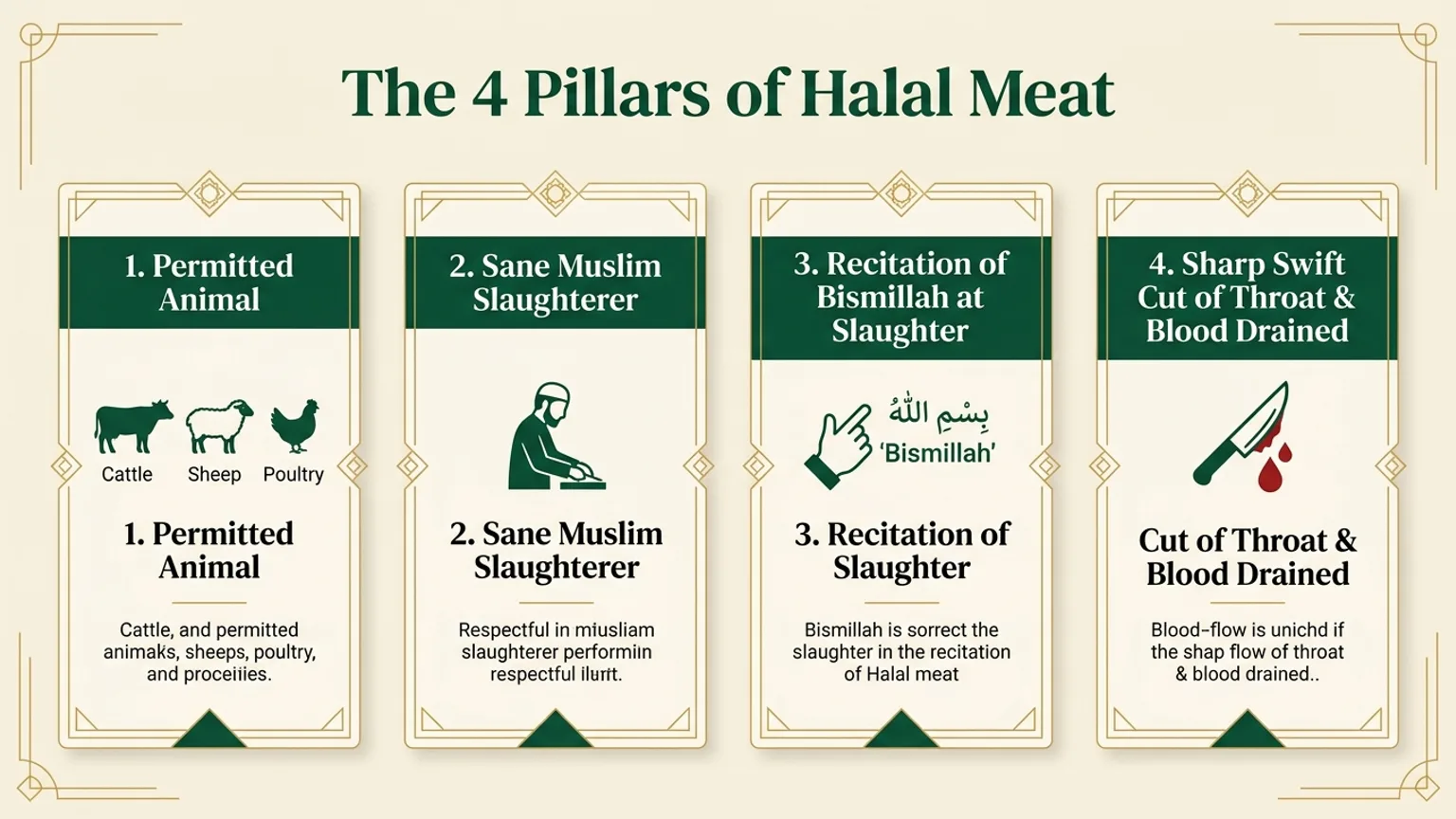
For any food or drink, four things decide whether it’s halal:
| Condition | What it means | Example |
|---|---|---|
| 1. The source is permitted | It isn’t from a forbidden animal or substance | Beef, not pork |
| 2. Meat is properly slaughtered | Zabiha method, with Allah’s name | Halal chicken, not carrion |
| 3. It isn’t mixed with anything haram | No pork derivatives, blood or alcohol added | Plain crisps, not crisps with pork gelatin |
| 4. It doesn’t intoxicate or harm | No intoxicants; not poisonous | Juice, not wine |
Most foods pass all four without anyone thinking about it. Here’s how the main food groups compare.
| Food group | Halal? | What to watch for |
|---|---|---|
| Fruit, vegetables, grains, nuts, pulses | Halal | Nothing, unless cooked with haram ingredients |
| Milk, butter, yoghurt | Halal | Nothing, in plain form |
| Cheese | Usually halal | Animal rennet or pork enzymes. See is cheese halal |
| Eggs | Halal | Nothing, from any permitted bird |
| Fish | Halal in every school | No slaughter needed |
| Other seafood | Halal for most schools | Hanafi scholars debate prawns and shellfish. See are prawns halal |
| Beef, lamb, goat, camel | Halal if slaughtered correctly | Slaughter method, certification |
| Chicken, turkey, duck | Halal if slaughtered correctly | Machine slaughter, stunning. See is chicken halal and is duck halal |
| Sweets and desserts | Often halal | Gelatin, carmine, alcohol flavourings. See is gelatin halal |
| Drinks | Halal unless intoxicating | Alcohol, including in “0%” beers. See is kombucha halal |
| Processed foods | Check | E-numbers such as E631, flavourings, emulsifiers |
Which animals are halal?
The Quran says, “All grazing livestock has been made lawful to you” (Surah Al-Ma’idah 5:1), and “It is lawful for you to hunt and eat seafood, as a provision for you and for travellers” (Surah Al-Ma’idah 5:96).
| Animal | Status | Notes |
|---|---|---|
| Cattle, sheep, goats, camels, buffalo | Halal | Must be slaughtered correctly |
| Deer, antelope and other wild grazers | Halal | Slaughtered or hunted by the Islamic rules |
| Chicken, turkey, duck, goose, quail, pigeon | Halal | Must be slaughtered correctly |
| Rabbit | Halal in the four Sunni schools | Not permitted in the Ja’fari (Shia) school |
| Horse | Halal for most; disliked (makruh) for Abu Hanifa | See is horse meat halal |
| Fish | Halal in every school | No slaughter needed |
| Prawns, crab, lobster, octopus | Halal for Shafi’i, Maliki, Hanbali | Hanafi views differ. See lobster and octopus |
| Locusts | Halal | Permitted by hadith without slaughter |
| Pigs, predators with fangs, birds with talons, donkeys | Haram | See what is haram |
What is halal meat? Zabiha slaughter explained
Meat is where halal gets detailed. For meat from a permitted land animal or bird to be halal, it has to be slaughtered by the Islamic method, called zabiha or dhabiha. The Prophet (peace be upon him) summed it up:
“if the killing tool causes blood to gush out, and if Allah’s Name is mentioned, eat (of the slaughtered animal).” (Sahih al-Bukhari 5503)
And the Quran says, “Do not eat of what is not slaughtered in Allah’s Name” (Surah Al-An’am 6:121).
The requirements of zabiha
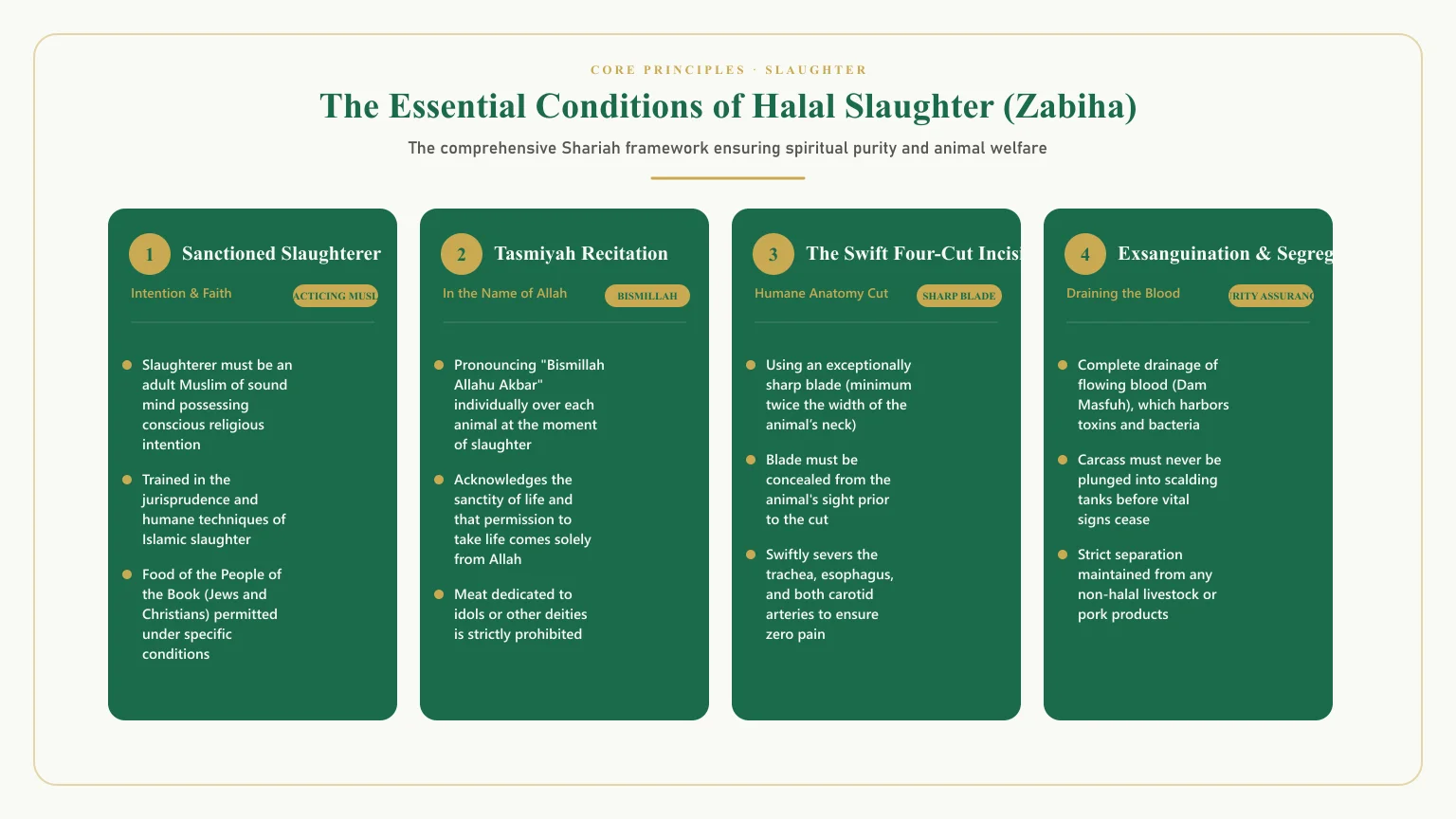
Scholars and certifiers such as the Halal Monitoring Committee (HMC) list these conditions:
- The animal is alive and healthy at the moment of slaughter.
- The slaughterer is a Muslim, sane and of age. Some scholars also accept a Christian or Jew (see below).
- Allah’s name is said, usually “Bismillah, Allahu Akbar”, over the animal at the time of slaughter.
- A very sharp knife is used, so the cut is quick and the animal suffers as little as possible.
- The throat is cut so that the windpipe, the food pipe and the two jugular veins are severed. HMC requires at least three of these four.
- The blood drains out. Flowing blood is forbidden to eat.
- The animal is treated kindly. It shouldn’t see the blade sharpened or another animal slaughtered.
Saying Allah’s name: the four schools
The schools agree the tasmiyah should be said. They differ on what happens if it’s left out:
| School | Tasmiyah | If left out on purpose | If forgotten |
|---|---|---|---|
| Hanafi | Required | Not halal | Halal |
| Maliki | Required when remembered | Not halal (main view) | Halal |
| Shafi’i | Recommended (sunnah), as Imam al-Nawawi explains in al-Majmu’ | Still halal | Halal |
| Hanbali | Required when remembered, as Ibn Qudamah records in al-Mughni | Not halal (main view) | Halal |
Stunning and machine slaughter: where certifiers disagree
Modern meat production raises two questions the classical books didn’t face. Certifiers answer them differently, which is why “halal” on one label can mean something different on another.
Stunning means making the animal unconscious before slaughter, usually with electricity or gas. The worry is that stunning could kill the animal before the cut, making it carrion.
| Certifier | Stunning |
|---|---|
| Halal Monitoring Committee (HMC), UK | Not accepted |
| Halal Food Authority (HFA), UK | Accepted if the animal is alive at the moment of slaughter |
| Halal Monitoring Authority (HMA), Canada | Only reversible methods (low voltage water bath for poultry, controlled atmosphere under strict conditions). Captive bolt rejected |
Machine slaughter is common for chickens: a rotating blade cuts thousands of birds an hour.
- HMA rejects it, because “it is impractical to bless each and every single bird individually prior to slaughter.”
- Mufti Muhammad Taqi Usmani, the Hanafi jurist and former judge of the Shariat Appellate Bench of Pakistan’s Supreme Court, argues in The Islamic Laws of Animal Slaughter that the tasmiyah must be said by the person slaughtering for each animal. On his view, most machine slaughter isn’t acceptable.
- Other certifiers accept it when a Muslim starts the line and Muslims recite the tasmiyah throughout. That’s how the chicken used at some US chains is certified, as we explain in our guide to Krispy Krunchy Chicken.
In practice, “zabiha” is often used to mean hand slaughtered, unstunned meat, while a general “halal” label may include stunned or machine slaughtered meat. If this matters to you, check which certifier is on the pack.
Meat from Christians and Jews
The Quran says, “the food of the People of the Book is permissible for you” (Surah Al-Ma’idah 5:5). Scholars agree this includes meat slaughtered by Christians and Jews in principle. They disagree on how it applies today.
- Sheikh Yusuf al-Qaradawi took a broad view: meat from Christian and Jewish countries is permissible unless you know it was killed in a forbidden way.
- Mufti Taqi Usmani and most halal certifiers take a strict view. They say industrial slaughter, often by people of no particular faith, with stunning and without God’s name, isn’t what the verse describes.
Most Muslims in the West follow the stricter view and buy certified meat.
Halal certification: who certifies, and what a logo means
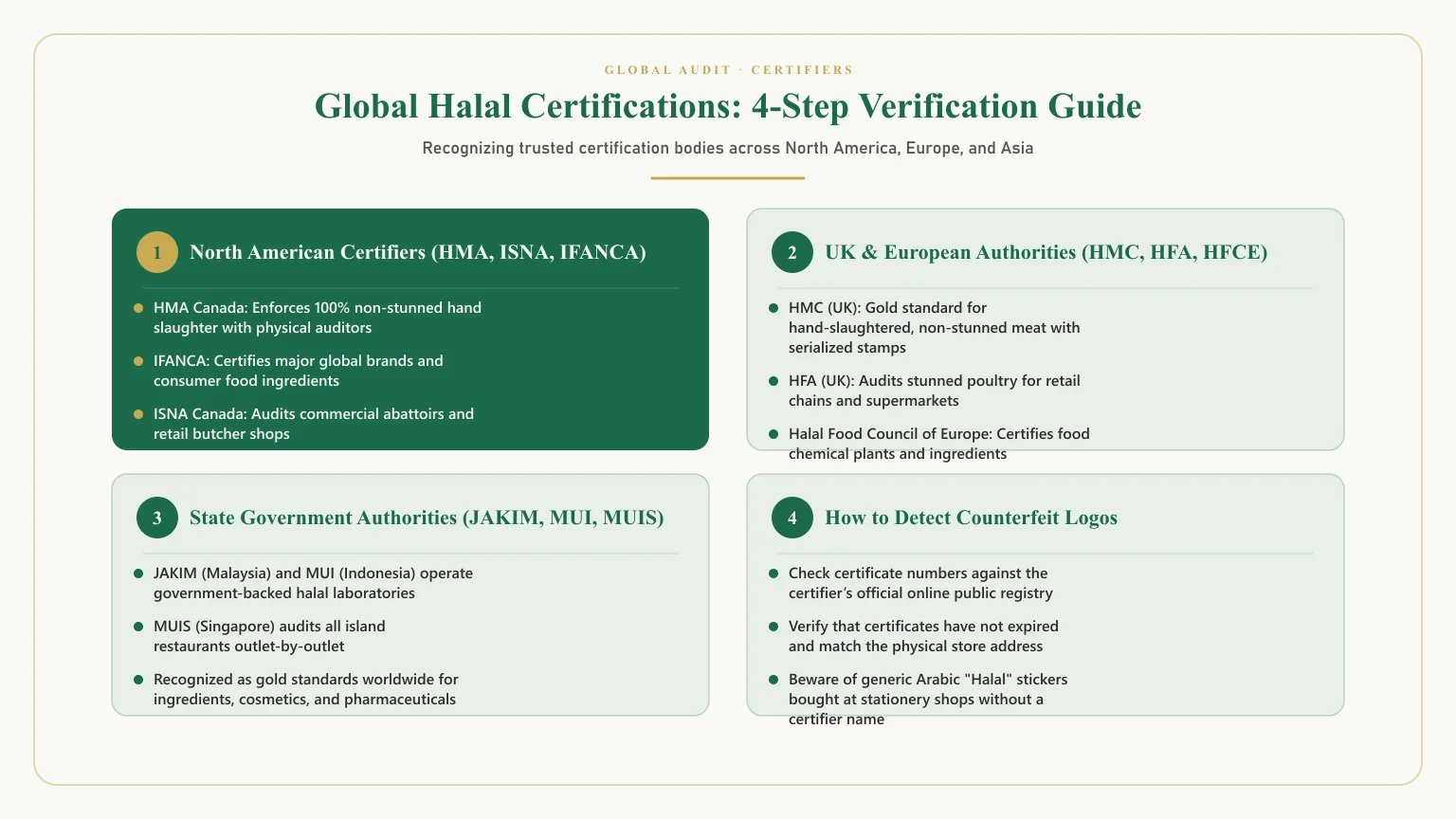
A halal certificate is a way of checking. It doesn’t make food halal. A plain apple is halal without one. But for meat and processed food, where you can’t see the source, certification is the practical way to know.
Major halal certifiers and standards
| Country or region | Main certifier(s) | Notes |
|---|---|---|
| Malaysia | JAKIM (government) | Uses the Malaysian halal standard MS 1500. Certifies premises, not just products |
| Singapore | MUIS (government) | Public register of certified outlets |
| Indonesia | BPJPH (government) with MUI | Halal certification is mandatory for most food and drink under Indonesia’s halal product law |
| Gulf states | National authorities | GCC standards such as GSO 2055-1 for halal products |
| Pakistan | Pakistan Halal Authority; SANHA Pakistan | See our E631 guide for a SANHA example |
| UK | HMC; HFA | HMC: hand slaughter, no stunning. HFA: accepts some stunning |
| US | IFANCA; ISNA Halal; American Halal Foundation | Varying standards on slaughter |
| Canada | HMA | Hand slaughter; reversible stunning only |
| South Africa | SANHA; NIHT; MJC | Several certifiers, different standards |
| International | OIC/SMIIC 1 | The Organisation of Islamic Cooperation’s general halal food standard |
Supplier certificate vs restaurant certificate
Restaurants cause the most confusion here. A supplier certificate says the meat was halal when it left the plant. A restaurant certificate says the certifier has checked the whole kitchen: every ingredient, the oil, storage, and whether any pork or alcohol is used.
In 2024, CBC Marketplace found that at several Canadian fast food chains, staff showed a supplier certificate as if it covered the whole restaurant. We cover this in our guides to KFC and Mary Brown’s. When a restaurant says “halal”, ask which kind of certificate it has.
Halal vs kosher
Halal and kosher are often compared, and they share a lot. But they aren’t the same.
| Halal | Kosher | |
|---|---|---|
| Pork | Forbidden | Forbidden |
| Blood | Forbidden | Forbidden |
| Slaughter | Cut to the throat by a Muslim, with Allah’s name | Cut to the throat by a trained Jewish slaughterer (shochet), with a blessing |
| God’s name | Said over each animal (per most schools) | A blessing said before slaughter, which can cover a session |
| Stunning | Disputed; some certifiers accept reversible stunning | Not permitted |
| Alcohol | Forbidden | Permitted, including kosher wine |
| Meat with dairy | Permitted | Forbidden to mix |
| Shellfish | Halal for most schools | Not kosher |
| Parts of the animal | All permitted parts may be eaten | Some parts and fats are excluded |
Is kosher halal? Some scholars accept kosher meat under Quran 5:5. Most halal certifiers don’t treat it as equivalent, mainly because of how God’s name is said. Kosher food can also contain alcohol, such as wine in sauces, which is never halal.
Halal beyond food
Halal isn’t just a food label. It’s a way of living within what Allah permits, and it covers:
- Earnings. Money must be earned honestly, without cheating, theft or forbidden work. The Prophet (peace be upon him) said, “Allah is Good and He therefore, accepts only that which is good” (Sahih Muslim 1015), and described a man whose prayers go unanswered because his food, drink and clothes came from unlawful sources. He also warned, “A time will come when one will not care how one gains one’s money, legally or illegally” (Sahih al-Bukhari 2059).
- Finance. Interest (riba) is forbidden, so Islamic banking uses profit sharing, leasing and trade instead.
- Medicine. Capsules may contain gelatin, and syrups may contain alcohol. Scholars allow some things under necessity. Ask your pharmacist for alternatives.
- Cosmetics and toiletries. Some contain animal fats, gelatin, carmine or alcohol. Rulings vary between things you eat and things you apply to the skin.
- Business and trade. Honest dealing, fair measures and no fraud are part of halal.
We explain the forbidden side of each of these in what is haram.
How to check if a product is halal
Here’s a practical checklist for shopping anywhere:
- Look for a halal logo from a certifier you trust. Check the certifier’s name, not just the word “halal”.
- Check whether it contains meat. If it does and there’s no certificate, assume it isn’t halal.
- Read the ingredients for the common problems: pork, lard, gelatin, animal rennet, alcohol, wine, carmine or cochineal (E120), and meat-derived flavourings.
- Look for “suitable for vegetarians” or “vegan”. These rule out meat, gelatin and animal fats, though not alcohol.
- Check E-numbers you’re unsure about. See our guides to E621 and E631.
- At restaurants, ask what the certificate covers, whether pork or alcohol is used, and whether fryers are shared.
- When in doubt, leave it. The Prophet (peace be upon him) told us to leave what makes us doubt for what doesn’t, but don’t forbid what’s clearly permitted either.
Find the answer for a specific food
We’ve researched the halal status of hundreds of foods, brands and ingredients. Some of the most asked:
- Fast food: KFC, Popeyes, Nando’s, Five Guys, Chick-fil-A, Wingstop, Domino’s
- Snacks and sweets: Doritos, Takis, Skittles, Oreo, Smarties
- Drinks: Red Bull, Monster, Prime, kombucha, bubble tea
- Ingredients: gelatin, cheese, vanilla extract, spirit vinegar, white wine vinegar
- Meat and seafood: chicken, duck, prawns
Final thoughts
Halal means permitted, and in Islam the default is that food is permitted. Plants, dairy, eggs and fish are halal unless something haram is added. Meat needs a permitted animal, the zabiha method and Allah’s name, and that’s where scholars and certifiers differ, especially on stunning and machine slaughter. A certificate helps you check, and knowing which certifier you trust matters more than the word “halal” on its own.
Allah says, “Eat of the good, lawful things provided to you by Allah. And be mindful of Allah in Whom you believe” (Surah Al-Ma’idah 5:88). If you have a question about a food we haven’t covered, ask us through our Contact page.
Frequently Asked Questions
Sources & references16
We checked every claim in this guide against these sources.
- - title: "Quran 2:168 (eat what is lawful and good)"quran.com
- Quran 5:1 (grazing livestock made lawful)quran.com
- Quran 5:3 (forbidden foods and necessity)quran.com
- Quran 5:5 (food of the People of the Book)quran.com
- Quran 5:87 to 88 (do not forbid good things)quran.com
- Quran 5:96 (seafood)quran.com
- Quran 6:121 (Allah's name at slaughter)quran.com
- Quran 7:32 (who has forbidden lawful provisions)quran.com
- Jami at-Tirmidhi 1726 (what Allah was silent about is pardoned)sunnah.com
- Sahih Muslim 1955 (slaughter in a good way)sunnah.com
- Sahih al-Bukhari 5503 (what makes blood flow, with Allah's name)sunnah.com
- Sahih Muslim 1015 (Allah accepts only what is good)sunnah.com
- Sahih al-Bukhari 2059 (not caring how money is earned)sunnah.com
- Halal Monitoring Committee (HMC): Definition of halalhalalhmc.org
- Halal Monitoring Authority (HMA, Canada): What is halalhmacanada.org
- IslamQA 10887: What is haram and what is halal?islamqa.info