
Are Prawns Halal? What Each School of Thought Says, and Why
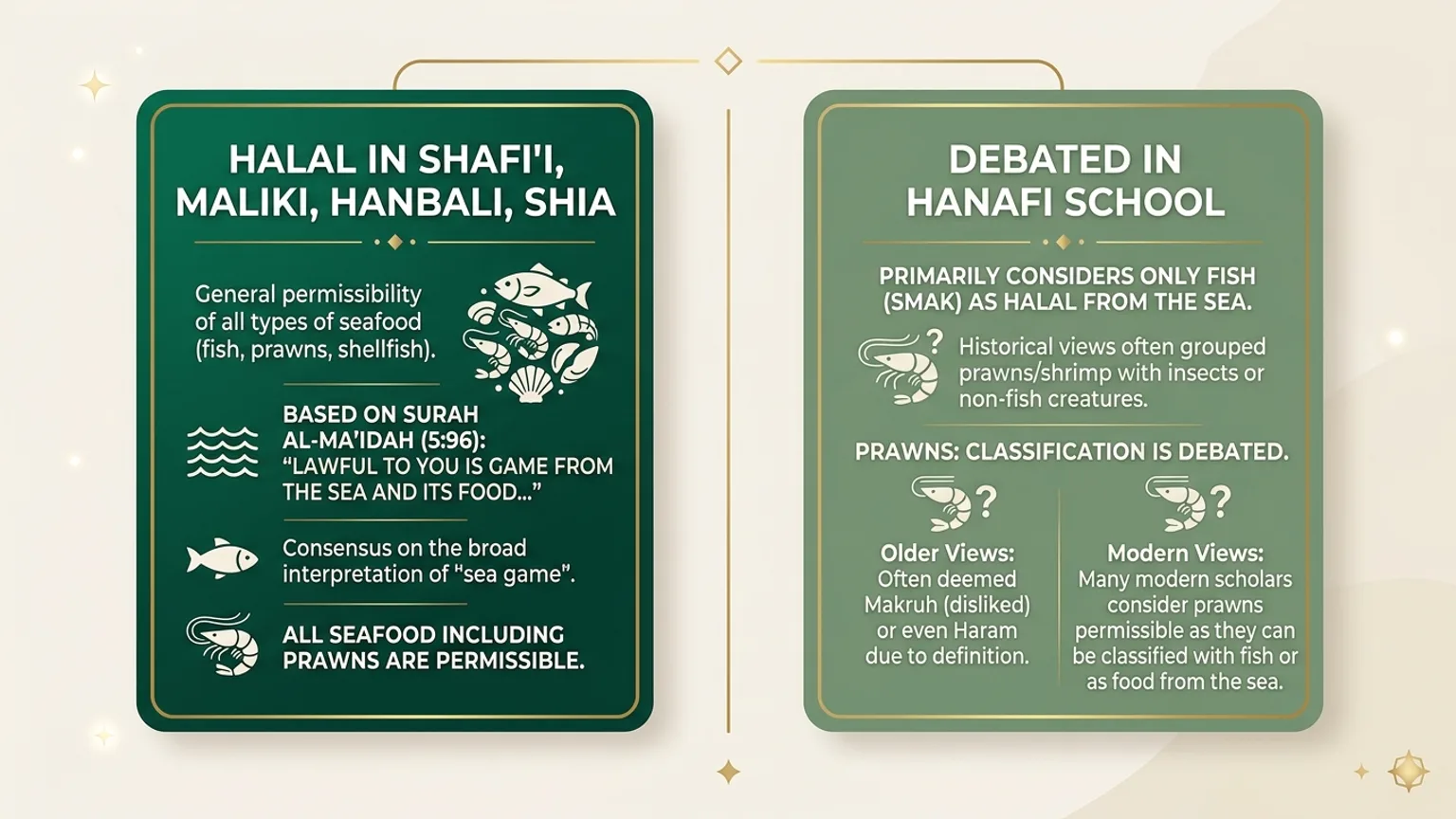
Prawns are halal in the Shafi'i, Maliki, Hanbali, and Shia schools of thought. In the Hanafi school, their status is debated: some scholars consider them permissible, many view them as disliked (makruh), and some hold they are not permitted because they may not qualify as fish (samak).
⚠️ DisputedIn this guide12 sections
- Quick answer by school of thought
- What the Quran and hadith say about seafood
- The Hanafi view in detail
- The Shafi’i, Maliki and Hanbali views
- The Shia (Ja’fari) view
- Prawns vs other seafood
- Prawn or shrimp: is there a difference?
- Do prawns need to be slaughtered?
- Eating prawns outside the home
- Final thoughts
- Frequently asked questions
- Related guides
Prawns are halal for most Muslims. The Shafi’i, Maliki and Hanbali schools permit all creatures of the sea, prawns included. Shia scholars, including Ayatollah Sistani, also permit prawns and shrimp. The only real debate is in the Hanafi school, which permits only fish from the sea. Hanafi scholars disagree on whether a prawn counts as a fish, so their answers range from permissible, to disliked (makruh), to not permitted.
If you follow the Hanafi school, the short version is this. Many Hanafi scholars say prawns aren’t haram but it’s better to avoid them. Others say they’re not permitted. Below, you’ll find each view, the evidence behind it, and practical answers about prawns in restaurants and takeaways.
Quick answer by school of thought
| School | Prawns and shrimp | Reason | Key source |
|---|---|---|---|
| Shafi’i | Halal | All sea creatures are permitted | Quran 5:96 and the hadith “its dead is lawful” |
| Maliki | Halal | All sea creatures are permitted | Same evidence |
| Hanbali | Halal | All sea creatures are permitted, with a few named exceptions such as frogs | Same evidence |
| Hanafi | Debated: permissible, makruh, or not permitted | Only fish (samak) are permitted from the sea; scholars differ on whether prawns are samak | Al-Hidayah; classical dictionaries; Mufti Taqi Usmani’s Fiqhi Maqalat |
| Ja’fari (Shia) | Halal | Prawns count as having scales, which is the Shia test for sea creatures | Ayatollah Sistani’s rulings |
What the Quran and hadith say about seafood
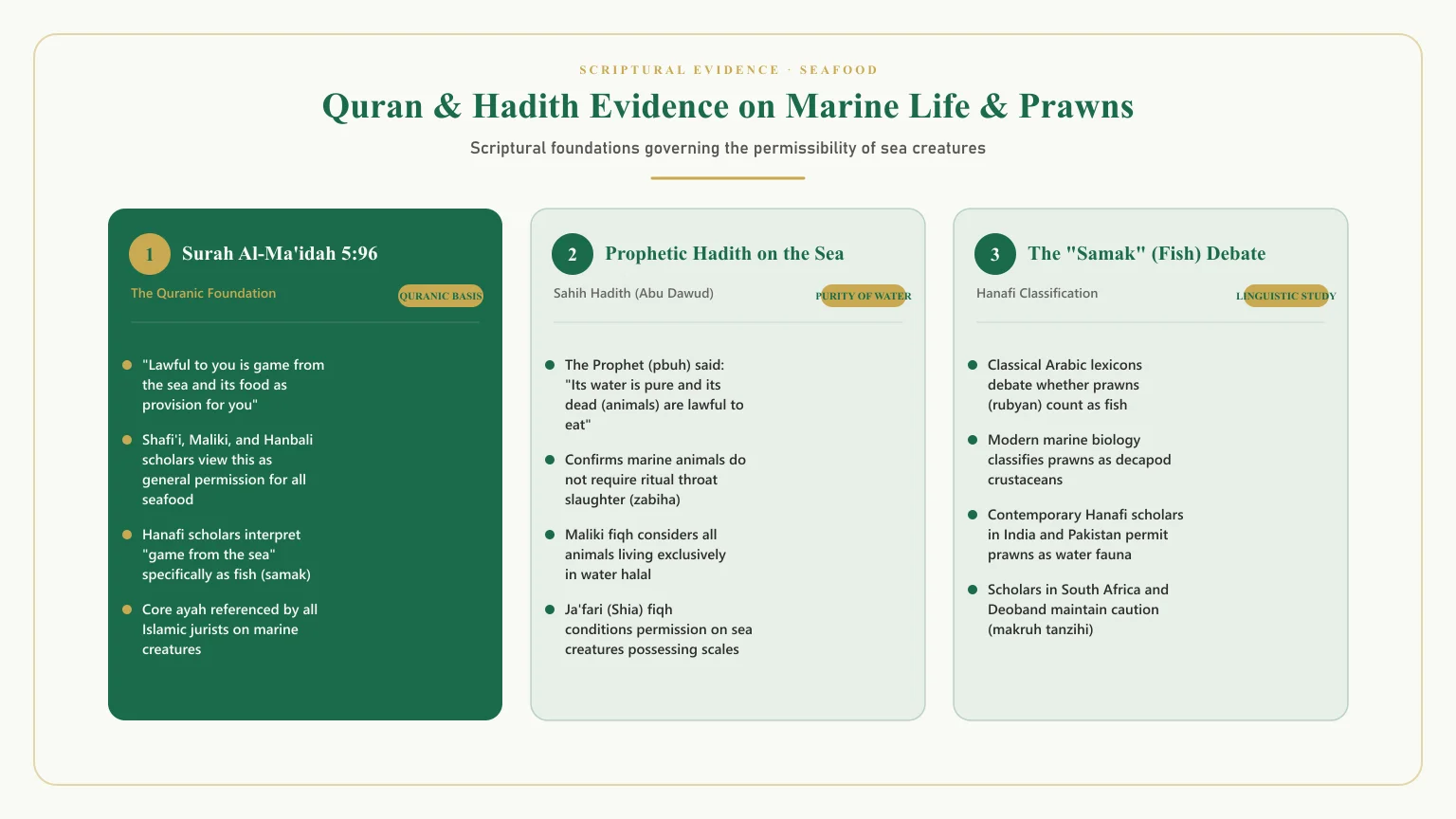
The Quran says: “Lawful to you is the game of the sea and its food, as provision for you and for travellers” (Surah Al-Ma’idah 5:96). Scholars agree this verse permits seafood. They disagree on what “game of the sea” covers.
Two hadith sit at the centre of the debate:
- When asked about the sea, the Prophet (peace be upon him) said, “Its water is pure and its dead is lawful.” This is recorded by Abu Dawud and al-Tirmidhi.
- He also said, “Two dead things and two bloods have been made lawful for us. The two dead things are fish and locusts.” This is recorded by Ibn Majah.
The Shafi’i, Maliki and Hanbali schools read the first hadith broadly: whatever lives only in the sea is lawful, even if found dead. The Hanafi school reads the second hadith as a limit: of all dead sea creatures, only fish are named, so only fish are permitted.
That single difference explains almost every ruling on seafood, from prawns to crab to octopus.
The Hanafi view in detail
For Hanafis, the question isn’t “does it live in the sea?” It’s “is it samak?”, the Arabic word for fish. Here the scholars split into three positions.
1. Permissible, but better to avoid
Mufti Muhammad ibn Adam of Darul Iftaa in Leicester writes that prawns are permissible because classical Arabic language experts, including al-Zabidi in Taj al-Arus and al-Fayruzabadi in al-Qamus, classify them as a type of fish. He adds that “to refrain and abstain is always advisable”.
2. Makruh, not haram
The classical scholar al-Damiri described prawns in Hayat al-Hayawan as “very small red fish”. Many Hanafi scholars in South Asia relied on this. Modern biology, however, says prawns lack the defining features of fish, such as a backbone and fins.
Mufti Taqi Usmani discusses both sides in Fiqhi Maqalat (volume 3, page 217). Because the evidence conflicts, the position summarised on IslamQA’s Tafseer Raheemi answer is that eating prawns can’t be called haram, but avoiding them is better. Many South Asian Hanafis follow this view.
3. Not permitted
Other Hanafi scholars hold that prawns are not samak, because the test is what the Arabs at the time of revelation would have called a fish, and a prawn doesn’t resemble one. Islam Answers UK calls this the sound opinion in the Hanafi school, citing al-Tahtawi, al-Marghinani, al-Quduri and Badr al-Din al-Ayni. The same answer notes that a Hanafi may follow the Shafi’i or Maliki view as a concession (rukhsah) where there is genuine need.
What this means if you’re Hanafi
All three positions are held by recognised Hanafi scholars. Prawns aren’t in the same category as pork or alcohol, which every school agrees are haram. If you’re unsure, follow the scholar or institution you usually rely on. Don’t criticise other Muslims who eat prawns, because most of the Muslim world does so on solid evidence.
The Shafi’i, Maliki and Hanbali views
These three schools treat everything that lives only in water as lawful, based on the verse “game of the sea” and the hadith “its dead is lawful”. Prawns, shrimp, lobster, squid and octopus are all halal for them, and none of these need to be slaughtered.
There are small differences on edge cases. Hanbalis exclude frogs and crocodiles, for example, and many Shafi’i scholars exclude crab. None of them question prawns.
One common mistake online is the claim that Imam Malik forbade prawns. He didn’t. The Maliki school is among the broadest on seafood.
The Shia (Ja’fari) view
Shia fiqh uses a different test. From the sea, only fish with scales are halal, and shrimp and prawns are named as halal too. Ayatollah Sistani’s rulings, published on Al-Islam.org, say prawns are halal “for scales cover their skin”.
As with fish, the prawn must be caught alive, that is, taken out of the water alive. Other shellfish, including lobster, crab, mussels and oysters, are not halal in Shia fiqh.
This is why some articles say prawns are halal “because they have scales” while others say prawns “have no scales”. The first is the Shia ruling. The second is a biological point some Hanafi scholars use. They’re answering different questions.
Prawns vs other seafood
| Seafood | Shafi’i, Maliki, Hanbali | Hanafi | Shia (Ja’fari) |
|---|---|---|---|
| Fish with scales | Halal | Halal | Halal |
| Fish without scales (e.g. catfish) | Halal | Halal | Not halal |
| Prawns and shrimp | Halal | Debated | Halal |
| Lobster | Halal | Not permitted | Not halal |
| Crab | Halal for Malikis and Hanbalis; many Shafi’is exclude it | Not permitted | Not halal |
| Squid and octopus | Halal | Not permitted | Not halal |
| Mussels and oysters | Halal | Not permitted | Not halal |
For more on individual creatures, see our guides to is lobster halal, is octopus halal and is fish halal.
Prawn or shrimp: is there a difference?
In fiqh, no. Every school that discusses prawns gives shrimp the same ruling, and our guide to is shrimp halal reaches the same answer.
In biology, prawns and shrimp are close relatives, both decapod crustaceans with ten legs and an outer shell. Scientists separate them by their gills and body shape. Prawns have branching gills and three pairs of claws, while true shrimp have plate like gills and two pairs. In everyday English, “prawn” is more common in the UK, Ireland, Australia and South Asia, and “shrimp” in North America. Menus use both words for the same thing, so the ruling doesn’t depend on the name.
King prawns and tiger prawns are simply larger species. They take the same ruling as any other prawn.
Do prawns need to be slaughtered?
No. For every school that permits them, prawns are like fish: no slaughter and no tasmiyah are needed. You can buy them from any shop, as long as nothing haram has been added.
The Shia condition is slightly different. The prawn must be taken out of the water alive, which is the normal practice for commercially caught prawns.
Eating prawns outside the home
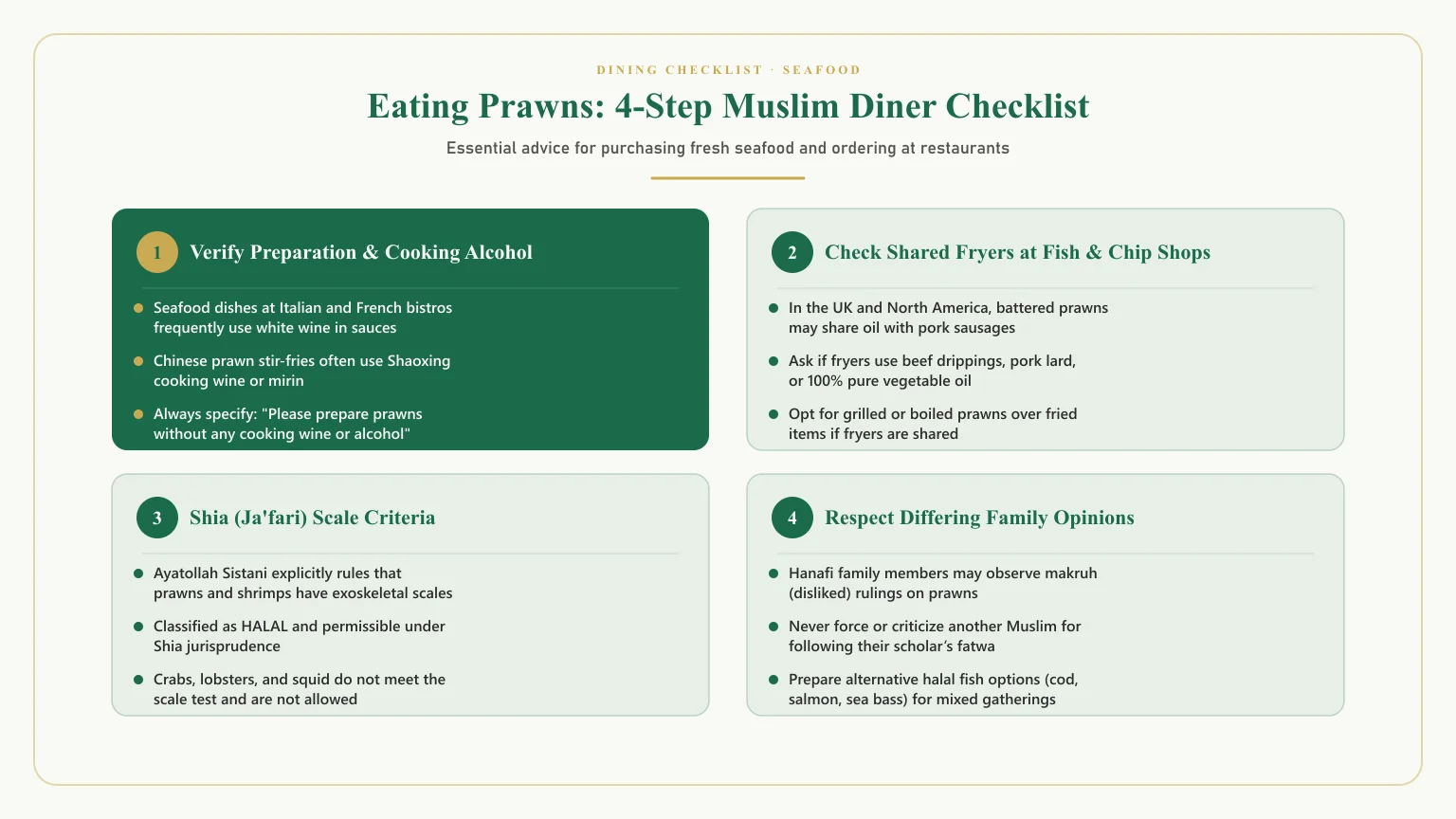
A halal ruling on prawns doesn’t make every prawn dish halal. Check these points:
- Alcohol in the sauce. Garlic prawns, scampi, paella and some Chinese dishes are often cooked with wine or rice wine. Ask the kitchen.
- Shared fryers and pans. In restaurants that serve pork, battered prawns may share oil with pork or non halal chicken. If you avoid cross contamination, ask.
- Prawn crackers. These are usually made from starch, prawn, salt and oil. Check the pack for flavourings and colours, and look for a halal or vegetarian mark.
- Stock and seasoning. Some prawn dishes use chicken or pork stock. Tom yum soup, ramen and some curries are common examples.
- Takeaways and sushi. Prawn tempura and prawn sushi are usually fine, but the tempura batter can share oil with other items, and some sushi rice uses mirin, a rice wine.
Final thoughts
For most Muslims, prawns are halal with no slaughter needed, and the debate you may have heard is an internal Hanafi one. If you’re Hanafi, follow the scholar you trust, and remember that the scholars who discourage prawns mostly call them disliked rather than forbidden. Whatever your school, check restaurant prawn dishes for wine and shared fryers. If you think we’ve missed a scholar’s view, tell us through our Contact page.
Frequently Asked Questions
Sources & references6
We checked every claim in this guide against these sources.
- Darul Iftaa (Leicester), via IslamQA: The ruling on prawns in the Hanafi schoolislamqa.org
- IslamQA (Tafseer Raheemi): Are prawns halal?islamqa.org
- Islam Answers UK: Are prawns halal in the Hanafi madhab?islamanswers.co.uk
- Al-Islam.org: Is eating prawns halal? (Ayatollah Sistani)al-islam.org
- IslamWeb fatwa 85741: Eating prawnsislamweb.net
- IMAM-US: Is lobster halal? (Shia ruling on crustaceans)imam-us.org