
E621 Halal or Haram? MSG, Ajinomoto and the Pork Question
E621 (monosodium glutamate, or MSG) is halal for most scholars and certifiers. It's made by bacteria fermenting sugar cane, beet, tapioca or corn, with no animal ingredients in the final product. It's called doubtful online because of a 2001 case in Indonesia, where a pork-derived ingredient was used in the growth medium. That was changed, and certified MSG is widely available.
✅ HalalIn this guide10 sections
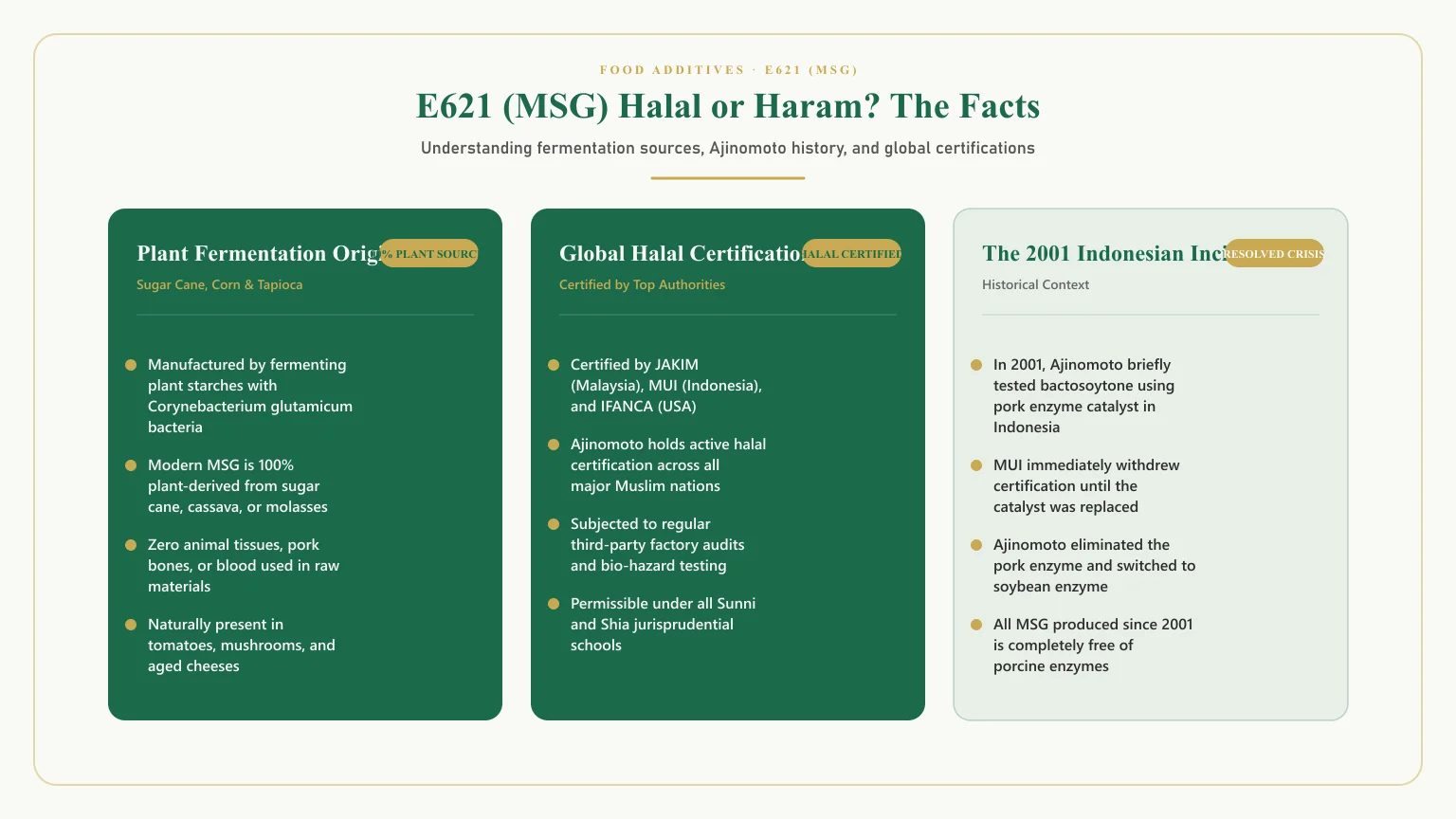
E621 is monosodium glutamate (MSG), and it’s halal for most scholars and halal certifiers. It’s made by bacteria that ferment plant sugars and starches, such as sugarcane molasses, sugar beet, tapioca or corn. There’s no pork, meat or alcohol in the finished product.
So why do some websites call it doubtful? Almost entirely because of one case in Indonesia in 2001, when a pork-derived ingredient was used to feed the bacteria. That case was real, the product was recalled, and the recipe was changed. This guide explains what happened, what scholars said, and how to check the MSG in your food.
Quick answer
| Question | Answer |
|---|---|
| What is E621? | Monosodium glutamate (MSG), a flavour enhancer that adds umami taste |
| What is it made from? | Plant sugars and starches fermented by bacteria |
| Any animal ingredient in the final product? | No |
| Halal? | Yes, for most scholars and certifiers |
| Why “mushbooh” on some sites? | The 2001 Ajinomoto case, where a pork-derived ingredient was used in the growth medium |
| Is MSG halal certified? | Widely, in Muslim majority countries (e.g. Ajinomoto in Indonesia and Malaysia) |
| Vegan? | Usually yes |
What E621 is and how it’s made
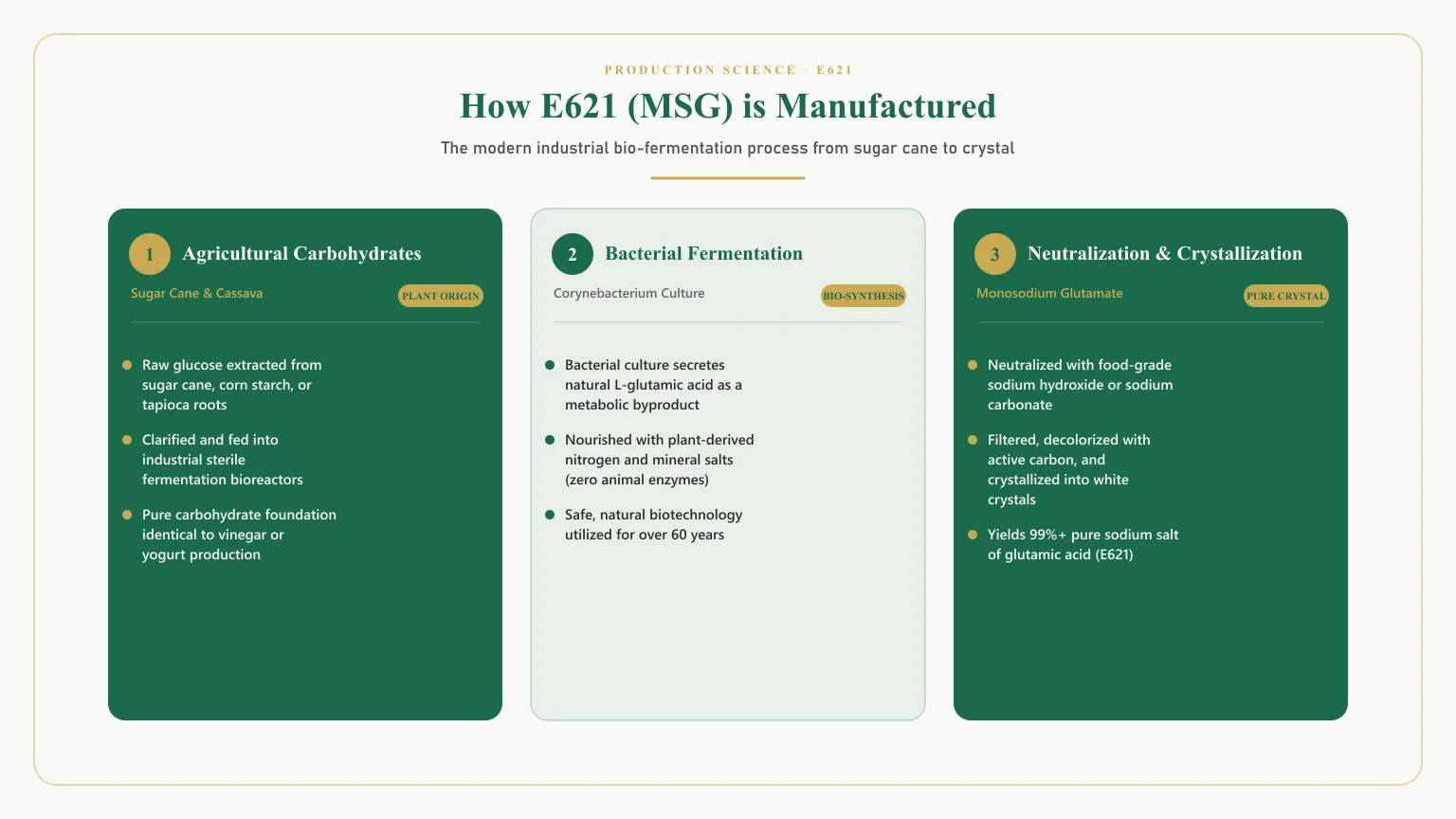
MSG is the sodium salt of glutamic acid, an amino acid found naturally in foods like tomatoes, mushrooms, aged cheese and seaweed. It gives food a savoury, meaty taste called umami.
The Japanese chemist Kikunae Ikeda first isolated it in 1908 from kombu seaweed, and in 1909 it went on sale under the name Ajinomoto, meaning “essence of taste”. Today it’s made in huge fermentation tanks:
- Sugar is fed to bacteria. The feed is usually molasses from sugarcane or sugar beet, or glucose from tapioca or corn starch.
- The bacteria make glutamate. A bacterium called Corynebacterium glutamicum releases glutamic acid into the liquid as it grows. It also needs nutrients, known as the culture medium, to grow well.
- The glutamate is purified. It’s separated, neutralised with sodium to make MSG, filtered and crystallised into the white powder you see.
That second step is where the halal question comes from. The bacteria need a nutrient source, and in 2001 one factory used an ingredient made with a pork enzyme.
The Ajinomoto Indonesia case (2001)
In September 2000, Indonesia’s halal certifier, the Majelis Ulama Indonesia (MUI), began an audit of PT Ajinomoto Indonesia. It found the company was using bactosoytone, a nutrient for the bacteria that had been made using an enzyme from pigs. The ingredient wasn’t added to the MSG itself. It was used to grow the bacteria that made the MSG.
The case became public on 9 January 2001. What followed:
- MUI declared the affected MSG haram.
- Indonesia’s health minister ordered a recall of about 3,000 tonnes of MSG.
- Seven executives, Japanese and Indonesian, were named as suspects under consumer protection law.
- Ajinomoto apologised to Muslim consumers.
- On 20 February 2001, MUI approved a new formula that replaced bactosoytone with a soy-based nutrient called mameno. KH Ma’ruf Amin, then chair of MUI’s fatwa commission and later Vice President of Indonesia, announced that the new MSG was “declared being halal”, while the old batches remained haram.
That’s the origin of almost every “E621 might contain pork” warning online. It was about one factory’s growth medium in 2000, and it was fixed.
What Islamic law says
The starting point: things are permitted
Allah says, “It is He who created for you all of that which is on the earth” (Surah Al-Baqarah 2:29). Imam al-Suyuti, the Shafi’i jurist, records in al-Ashbah wa al-Naza’ir the principle that the default ruling for things is permissibility. MSG made from sugar and starch has nothing forbidden in it. The Quran’s list of forbidden foods, “dead animals, blood, the flesh of swine” (Surah Al-Ma’idah 5:3), doesn’t touch it.
The harder question: pork in the process, not the product
The 2001 case raises a real fiqh question. If a haram substance is used in making something, but none of it ends up in the final product, is the product haram?
- MUI’s answer in 2001 was yes. Using a pork-derived ingredient anywhere in the process made the product haram for its certification. Halal certifiers today generally apply the same standard: they check processing aids and growth media, not just final ingredients.
- Many scholars take a softer view of a substance that has fully transformed or disappeared (istihalah or istihlak). On that view, bacteria that grew on a medium and then made glutamate from sugar haven’t passed on anything forbidden.
In practice, you don’t need to settle this debate. The major makers switched to plant-based media after 2001, and certified MSG is easy to find.
Today’s rulings
Darul Ifta Birmingham (answer by Maulana Mustafa Umar, checked by Mufti Mohammed Tosir Miah) ruled Ajinomoto halal in 2021. It noted the seasoning is made from “molasses and tapioca starch derived from sugarcane”, and that these ingredients are halal.
Why some sites still say “mushbooh”
Some e-code apps label E621 as mushbooh (doubtful). Their reasoning is that a label can’t tell you what the bacteria were fed. The Prophet (peace be upon him) did teach caution with genuine doubt:
“Both legal and illegal things are evident but in between them there are doubtful (suspicious) things and most of the people have no knowledge about them. So whoever saves himself from these suspicious things saves his religion and his honor.” (Sahih al-Bukhari 52)
But most scholars don’t treat MSG as a genuine doubt today, for three reasons:
- The final product has no animal ingredient.
- The large manufacturers use plant-based media, and many hold halal certificates.
- Treating every fermented ingredient as doubtful would make most modern food, bread and vinegar included, impossible to eat. Allah says, “Allah intends for you ease and does not intend for you hardship” (Surah Al-Baqarah 2:185).
If you want to be extra careful, choose MSG or products with a halal logo. That settles it. The Prophet (peace be upon him) said, “Leave what makes you in doubt for what does not make you in doubt” (Jami at-Tirmidhi 2518), and with certified MSG so easy to find, there’s no need to guess.
E621 by country, and is it safe?
| Country | Status | Notes |
|---|---|---|
| Indonesia | Halal certified MSG widely sold | MUI approved the reformulated Ajinomoto in February 2001 |
| Malaysia | Halal certified MSG widely sold | Check for the JAKIM logo |
| Pakistan | Halal, but a court ban on health grounds | See below |
| UK | Halal by ingredients | Usually listed as “flavour enhancer (monosodium glutamate)” or E621 |
| Saudi Arabia and the Gulf | Permitted | Look for a recognised halal mark |
| US and Canada | Halal by ingredients | Listed as “monosodium glutamate” |
Is MSG banned in Pakistan?
Yes, on health grounds. Punjab, Khyber Pakhtunkhwa and Sindh banned MSG in early 2018. On 3 March 2018, the Supreme Court, led by Chief Justice Mian Saqib Nisar, banned its import, sale and export nationwide, calling it hazardous to health.
That ruling wasn’t about halal status. In December 2024, the federal cabinet approved a review petition after an expert committee found “no significant health risks” from MSG. If you sell or import MSG in Pakistan, check the current legal position.
Is MSG safe?
That’s a health question, not a halal one, but readers ask.
The US FDA classifies MSG as “generally recognized as safe”, and the EU permits it with limits. Blinded studies haven’t found that MSG causes “Chinese restaurant syndrome” when eaten with food at normal amounts. MSG contains about a third of the sodium of table salt by weight, so it can even help reduce salt. People who feel unwell after eating it can simply avoid it.
Where you’ll find E621
MSG is common in:
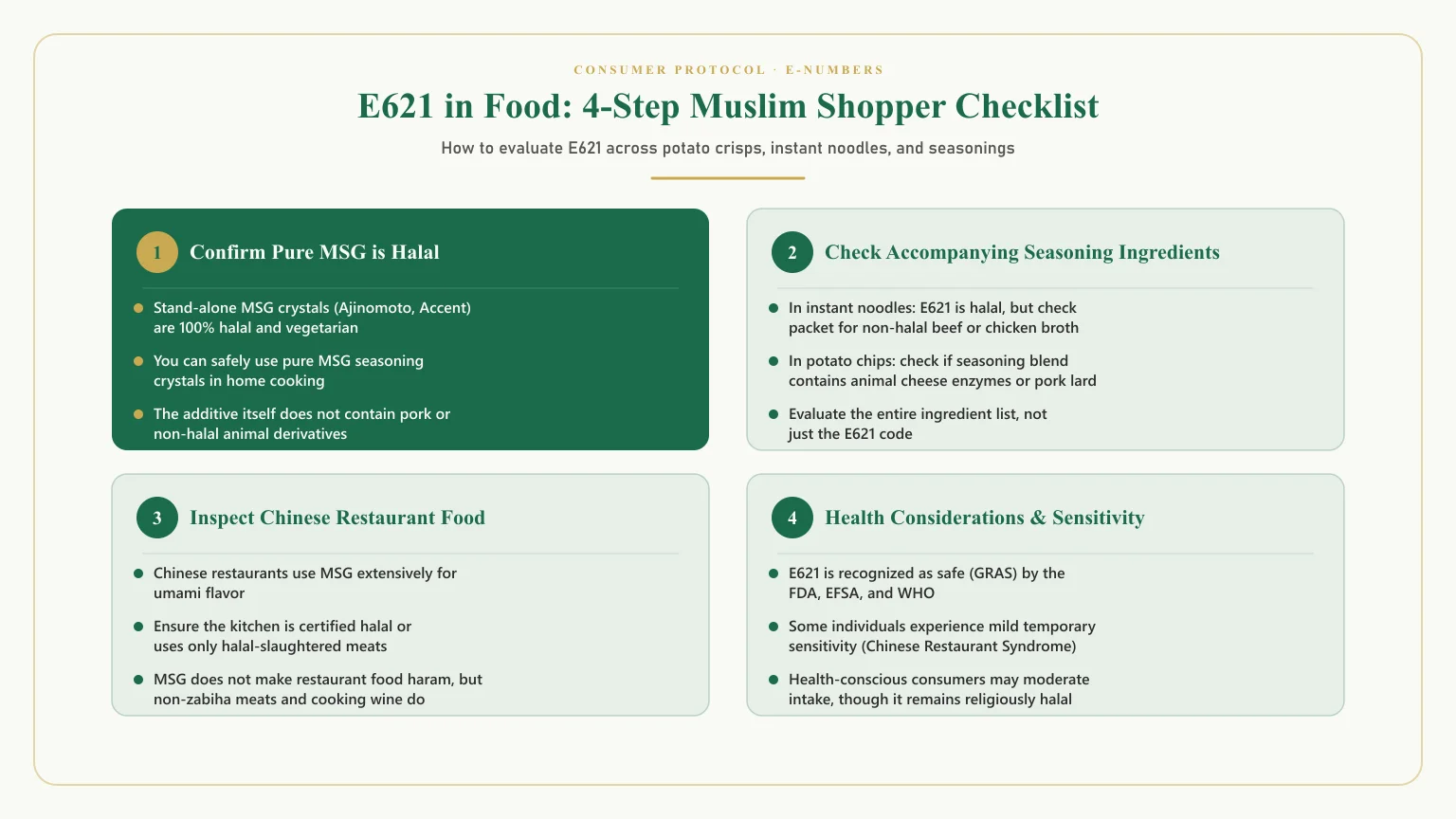
- Instant noodles and noodle seasoning
- Crisps and savoury snacks (see our guides to Doritos and Cheetos)
- Stock cubes, soups and gravy granules
- Seasoning mixes, spice blends and marinades
- Processed meats and ready meals
- Takeaway food, especially Chinese and South Asian
In Pakistan, you’ll also see it sold loose as “Chinese salt” or under the Ajinomoto brand name, which is why many people use “Ajinomoto” to mean any MSG.
On labels, it can appear as “E621”, “monosodium glutamate”, “MSG” or “flavour enhancer (E621)”. You may also see yeast extract or hydrolysed vegetable protein, which contain glutamate naturally but aren’t labelled as MSG. Yeast extract is halal; hydrolysed protein is halal when it’s from plants, which the label usually states.
It’s often paired with E631 and E627, which boost its effect. Those two are a different story, because they can come from fish or meat. See our guide to E631.
Final thoughts
E621 is MSG, and it’s halal for most scholars and certifiers. It’s made by fermenting plant sugars, and nothing from an animal ends up in it. The “pork” worry comes from Ajinomoto Indonesia’s growth medium in 2000, which was replaced in February 2001 and approved by MUI. Pakistan’s ban was about health, not halal status, and it’s now under review.
If you want certainty, buy MSG or snacks with a halal logo. If you spot an E621 product with a questionable source, tell us through our Contact page.
Frequently Asked Questions
Sources & references12
We checked every claim in this guide against these sources.
- - title: "Quran 2:29 (all on earth created for you)"quran.com
- Quran 5:3 (prohibited foods)quran.com
- Quran 2:185 (Allah intends ease)quran.com
- Sahih al-Bukhari 52 (doubtful matters)sunnah.com
- Jami at-Tirmidhi 2518 (leave what makes you in doubt)sunnah.com
- Darul Ifta Birmingham: Is Ajinomoto halal? (2021)islamqa.org
- just-food: International outrage over Ajinomoto's use of pork enzyme (Jan 2001)just-food.com
- just-food: Ajinomoto receives MUI approval for new MSG product (Feb 2001)just-food.com
- FoodNavigator: Ajinomoto apologises to Muslims (Jan 2001)foodnavigator.com
- Dawn: Supreme Court bans 'Chinese salt' across country (Mar 2018)dawn.com
- Profit: Govt to challenge Supreme Court's ban on Chinese salt (Dec 2024)profit.pakistantoday.com.pk
- Wikipedia: Monosodium glutamateen.wikipedia.org