
Is Octopus Halal? Squid and Calamari Rulings by School
Octopus, squid and cuttlefish are halal in the Shafi'i, Maliki and Hanbali schools, which permit all sea creatures. They aren't permitted in the Hanafi school, which allows only fish, or for Shia Muslims, who allow only scaled fish and shrimp. Check calamari batter, fryers and sauces for alcohol or pork.
⚠️ DisputedIn this guide8 sections
Whether octopus is halal depends on your school. The Shafi’i, Maliki and Hanbali schools permit everything that lives only in the sea, so octopus, squid and cuttlefish are halal for them. The Hanafi school permits only fish, and Shia scholars permit only scaled fish and shrimp, so octopus isn’t permitted for either.
We’ve also corrected a claim from our old version of this page. It said octopuses “don’t feel pain”. That’s wrong: a 2021 review for the UK government found octopuses are sentient. This guide gives each school’s ruling, what to check in dishes like calamari and takoyaki, and what Islam says about how they’re killed.
Quick answer
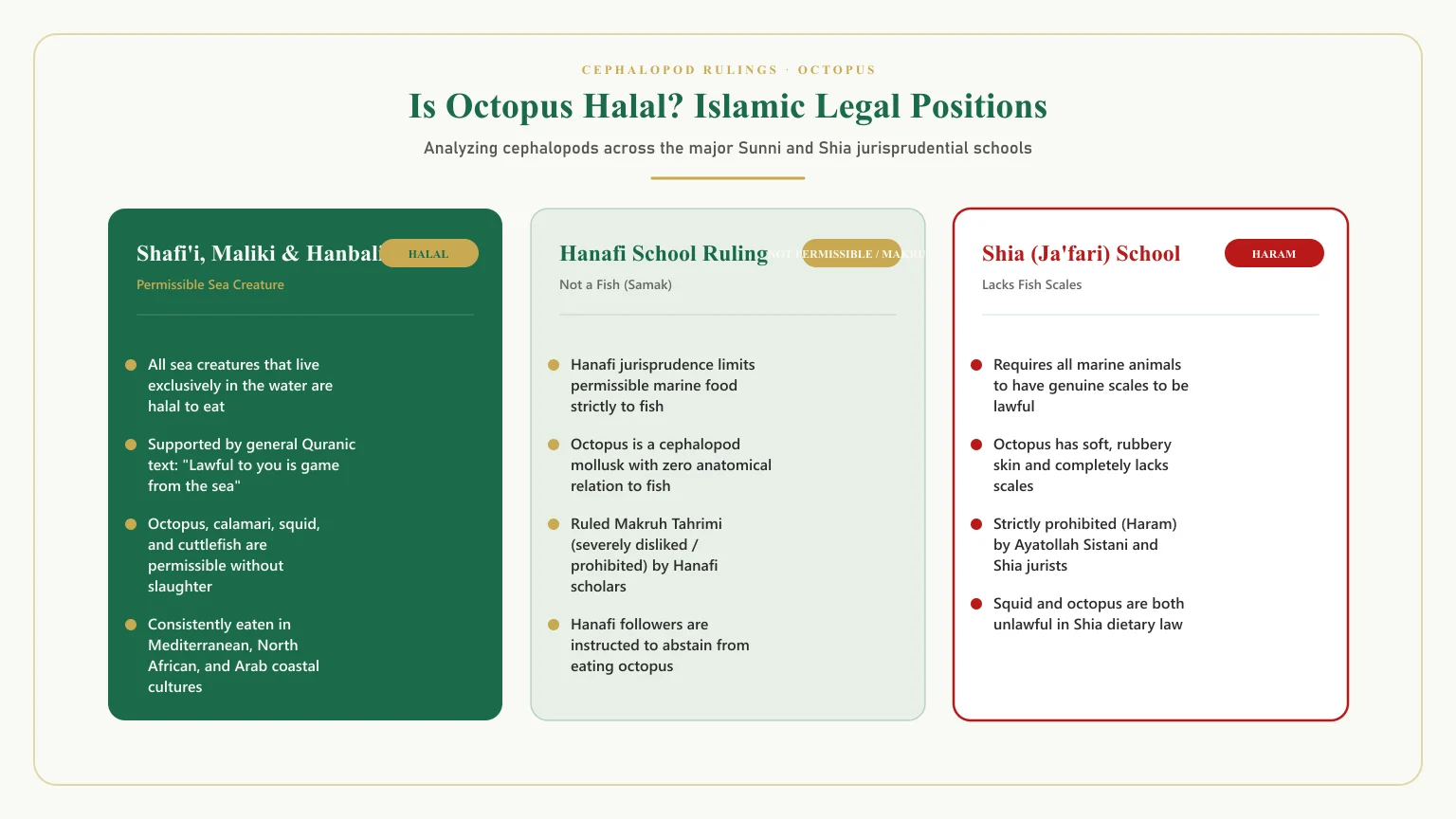 by school
| School | Octopus | Squid, calamari, cuttlefish |
|---|---|---|
| Shafi’i | Halal | Halal |
| Maliki | Halal | Halal |
| Hanbali | Halal | Halal |
| Hanafi | Not permitted | Not permitted |
| Ja’fari (Shia) | Not permitted | Not permitted |
Squid, cuttlefish and calamari take the same ruling as octopus in every school. They’re all cephalopods: soft bodied sea animals with no scales, and none of them is a fish. So there’s no school that permits octopus but not squid, or the other way round. Calamari is simply the culinary name for squid, usually sliced into rings and fried.
If your school permits one, it permits all of them, and if it doesn’t, it doesn’t permit any. The only extra question is what the dish is cooked with, which we cover below.
The evidence, and why schools differ
Allah says, “It is lawful for you to hunt and eat seafood, as a provision for you and for travellers” (Surah Al-Ma’idah 5:96), and describes the sea as a source of “tender seafood” (Surah An-Nahl 16:14). The Prophet (peace be upon him) said of the sea, “Its water is pure, and its dead are lawful” (Jami at-Tirmidhi 69).
The majority view. The Shafi’i, Maliki and Hanbali schools take these texts broadly: any creature that lives only in the sea is lawful, with a few named exceptions. Imam al-Nawawi (Shafi’i) and Ibn Qudamah (Hanbali) record this in al-Majmu’ and al-Mughni. Octopus and squid live only in the sea, so they’re halal for these schools.
The Hanafi view. The Hanafi school reads this hadith as setting the limit:
“Two kinds of dead meat and two kinds of blood have been permitted to us. The two kinds of dead meat are fish and locusts, and the two kinds of blood are the liver and spleen.” (Sunan Ibn Majah 3314)
Only fish are named from the sea. Darul Ifta Birmingham (Mufti Mohammed Tosir Miah) lists “squids, octopus” among the sea creatures Hanafis may not eat. Our old page described the Hanafi view as “makruh” (disliked). The Hanafi sources we checked say not permitted, so we’ve corrected it.
The Shia view. Sayyid Sistani’s office says that from marine animals, only “fish that has scale” and shrimp may be eaten. Octopus and squid have no scales and aren’t shrimp, so they’re not permitted.
Octopus and squid dishes: what to check
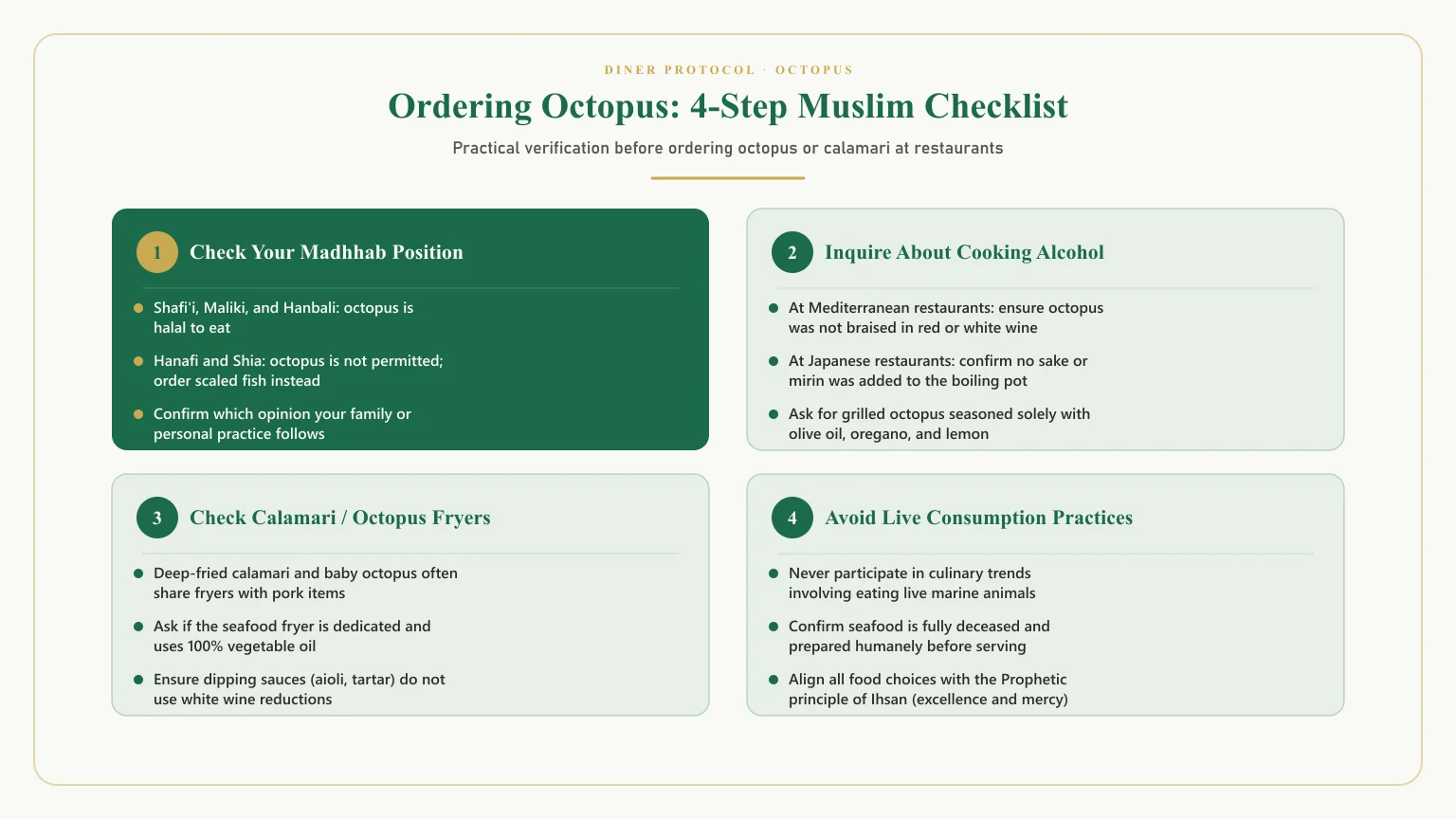
If your school permits octopus and squid, the dish still needs checking:
| Dish | What to check |
|---|---|
| Fried calamari | Beer batter in some restaurants; fryers shared with pork or non halal meat |
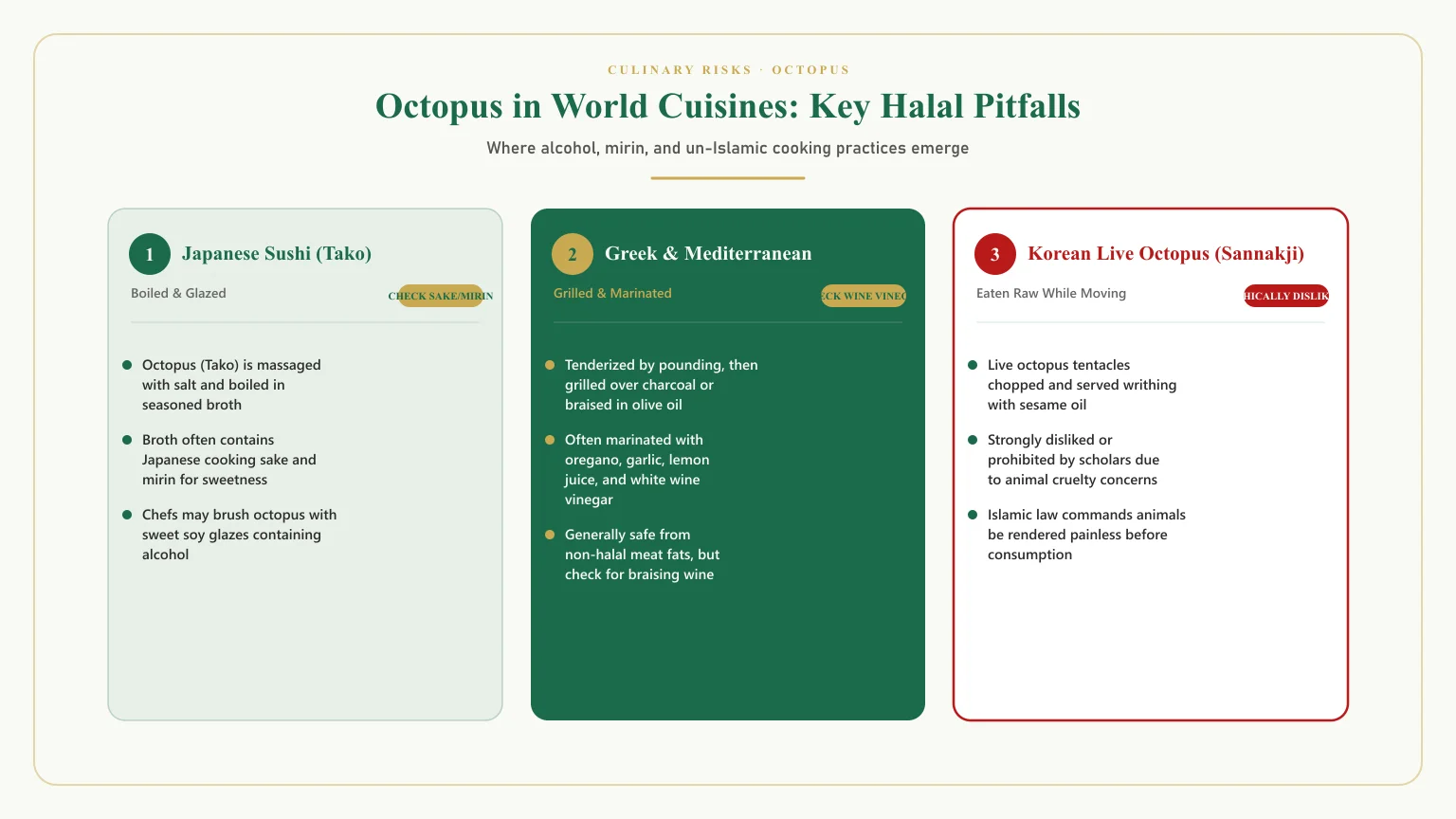
| Grilled octopus (Greek, Spanish, Portuguese) | Wine in marinades; chorizo served alongside |
| Pulpo a la gallega | Usually octopus, olive oil, paprika and salt: fine |
| Takoyaki (Japanese octopus balls) | Mirin in the sauce or batter; the bonito flakes on top are fish, which is fine |
| Squid ink pasta | Squid ink follows the squid ruling; check for white wine in the sauce |
| Korean and Chinese squid dishes | Rice wine or mirin in marinades |
| Sushi and sashimi (tako, ika) | Mirin in sushi rice and sauces |
| Dried squid snacks | Check the seasoning for alcohol or flavour enhancers like E631 |
Mirin and rice wine are made to be alcoholic drinks, so most scholars don’t allow them as added ingredients, even though some alcohol evaporates in cooking.
Do octopuses feel pain? What Islam teaches
Our old page claimed octopuses “don’t feel pain.” That’s not what the science says. In November 2021, a review commissioned by the UK government and led by Dr Jonathan Birch at the London School of Economics examined over 300 scientific studies. It concluded that octopuses, squid and cuttlefish, along with crabs and lobsters, can experience pain, distress or harm, and should be treated as sentient beings. The UK then included them in its Animal Welfare (Sentience) Act.
This doesn’t change whether octopus is halal for the schools that permit it. But the Prophet (peace be upon him) taught:
“Verily Allah has enjoined goodness to everything; so when you kill, kill in a good way and when you slaughter, slaughter in a good way.” (Sahih Muslim 1955)
So for those who eat octopus, a quick, humane method of killing is the Islamic ideal. Dishes where octopus is eaten while still alive, found in some cuisines, go against that teaching.
When friends or family follow different schools
This is one of the most common real life situations with seafood. A Shafi’i friend from Malaysia or Somalia may eat grilled squid without a second thought, while a Hanafi friend from Pakistan or Turkey won’t touch it. Both are following sound scholarship. Neither is being careless or overly strict.
Scholars across the schools teach that you shouldn’t criticise someone for following a valid position in their own school on a question where the schools differ. If you’re Hanafi and you’re offered calamari by a Shafi’i host, you can politely decline and choose something else. If you’re Shafi’i and you’re cooking for Hanafi or Shia guests, it’s good manners to offer a fish dish alongside, and to keep serving spoons separate.
Converts and people who don’t follow one school should pick one of the valid views and follow it consistently, ideally after asking a scholar they trust. Picking the easiest view on every question just to suit your wishes is something scholars warn against.
Final thoughts
Octopus, squid, calamari and cuttlefish are halal for Shafi’i, Maliki and Hanbali Muslims, and not permitted for Hanafi and Shia Muslims. Follow your own school. If you eat them, watch for beer batter, wine, mirin and shared fryers. And remember that octopuses are sentient: kindness in killing is part of the Islamic way.
For other seafood, see is fish halal, is shrimp halal, are prawns halal and is lobster halal. If you have a question we haven’t covered, ask us through our Contact page.
Frequently Asked Questions
Sources & references8
We checked every claim in this guide against these sources.
- - title: "Quran 5:96 (seafood lawful)"quran.com
- Quran 16:14 (eat tender seafood)quran.com
- Jami at-Tirmidhi 69 (the sea: its dead are lawful)sunnah.com
- Sunan Ibn Majah 3314 (fish and locusts)sunnah.com
- Sahih Muslim 1955 (kill in a good way)sunnah.com
- Darul Ifta Birmingham: What types of fish Hanafis may eatislamqa.org
- Office of Sayyid Sistani: Fish (Q&A)sistani.org
- LSE: Octopuses, crabs and lobsters to be recognised as sentient beings (Nov 2021)lse.ac.uk