What Is Haram? Meaning, Haram Foods and Ingredients List
Haram is an Arabic word meaning forbidden in Islam. Only Allah and His Messenger can make something haram. In food, it includes pork, blood, carrion, alcohol and other intoxicants, animals not slaughtered in Allah's name, predators with fangs, birds with talons and donkeys. Beyond food, it includes interest, gambling, cheating and other sins.
❌ HaramIn this guide14 sections
- Haram at a glance
- What does haram mean?
- Haram among the five rulings
- The list of haram foods, with the evidence
- Hidden haram: ingredients to watch for
- Doubtful things: mushbooh
- When haram becomes permitted: necessity
- Eating haram by mistake
- Haram beyond food
- Common myths about haram
- Why does Allah make things haram?
- Final thoughts
- Frequently asked questions
- Related guides
Haram is an Arabic word meaning forbidden. In Islam, it’s anything a Muslim must not do, eat or drink. Doing something haram knowingly is a sin, and avoiding it for Allah’s sake is rewarded. Its opposite is halal, meaning permitted.
In food, the haram list is short and specific: pork, blood, carrion, alcohol and other intoxicants, animals slaughtered in a name other than Allah’s, predators with fangs, birds with talons and donkeys. Almost everything else is halal. The real difficulty today is hidden ingredients, like gelatin, lard, alcohol in flavourings and some E-numbers.
This guide sets out what haram means in Islamic law, the full list of haram foods with the evidence for each, the ingredients to watch for, how to handle doubtful things, what to do if you eat something haram by mistake, and what haram means beyond food.
Haram at a glance
| Question | Short answer |
|---|---|
| What does haram mean? | Forbidden in Islam. Also “sacred”, as in Masjid al-Haram |
| Who decides what’s haram? | Only Allah and His Messenger |
| Is most food haram? | No. The default is that food is halal |
| Main haram foods | Pork, blood, carrion, intoxicants, meat not slaughtered in Allah’s name, predators, birds of prey, donkeys |
| Hidden haram ingredients | Lard, pork gelatin, pepsin, alcohol, some E-numbers |
| Eating haram by mistake | No sin. Stop once you know |
| Eating haram when starving | Permitted, only as much as needed |
| Beyond food | Interest, gambling, cheating, theft, and other sins |
What does haram mean?
The Arabic root h-r-m carries two connected meanings: forbidden and sacred (something protected from violation).
- In law, haram means an act that is forbidden. IslamQA defines it as something for which the doer may face punishment, while the one who avoids it for Allah’s sake is rewarded.
- In places, haram means a sanctuary. The Masjid al-Haram in Makkah is “the Sacred Mosque”, and the area around Makkah and Madinah is called the Haramayn, the two sanctuaries. Britannica notes that these sacred precincts have special rules against bloodshed and violence.
Both meanings share one idea: a boundary you don’t cross.
Only Allah can make something haram
People often call things haram without evidence, so this point matters. Allah says:
“Do not falsely declare with your tongues, ‘This is lawful, and that is unlawful,’ [only] fabricating lies against Allah. Indeed, those who fabricate lies against Allah will never succeed.” (Surah An-Nahl 16:116)
The Prophet (peace be upon him) said that what Allah “was silent about” is “among that for which He has pardoned” (Jami at-Tirmidhi 1726). Sheikh Yusuf al-Qaradawi lists this among the first principles of The Lawful and the Prohibited in Islam: the right to make things lawful or unlawful belongs to Allah alone, and forbidding what He allowed is as serious as allowing what He forbade.
Haram among the five rulings
Islamic law places every action in one of five categories. Knowing them stops people from confusing “not recommended” with “forbidden”.
| Ruling | Arabic | Meaning | Food example |
|---|---|---|---|
| Obligatory | Fard or wajib | Must be done; leaving it is a sin | Eating to stay alive |
| Recommended | Mustahabb or sunnah | Rewarded if done; no sin if left | Saying Bismillah before eating |
| Permitted | Mubah | Neutral | Choosing rice over bread |
| Disliked | Makruh | Rewarded if avoided; no sin if done | Eating raw onion or garlic before going to the mosque |
| Forbidden | Haram | Sin if done; rewarded if avoided for Allah | Eating pork |
The Hanafi school splits makruh in two:
- Makruh tahrimi is a strong dislike, close to haram.
- Makruh tanzihi is a mild dislike.
That’s why you’ll sometimes see Hanafi scholars call something “makruh” when other schools call it haram, or the reverse. Prawns are a good example: see are prawns halal.
The list of haram foods, with the evidence
What the Quran forbids
The fullest list is in Surah Al-Ma’idah:
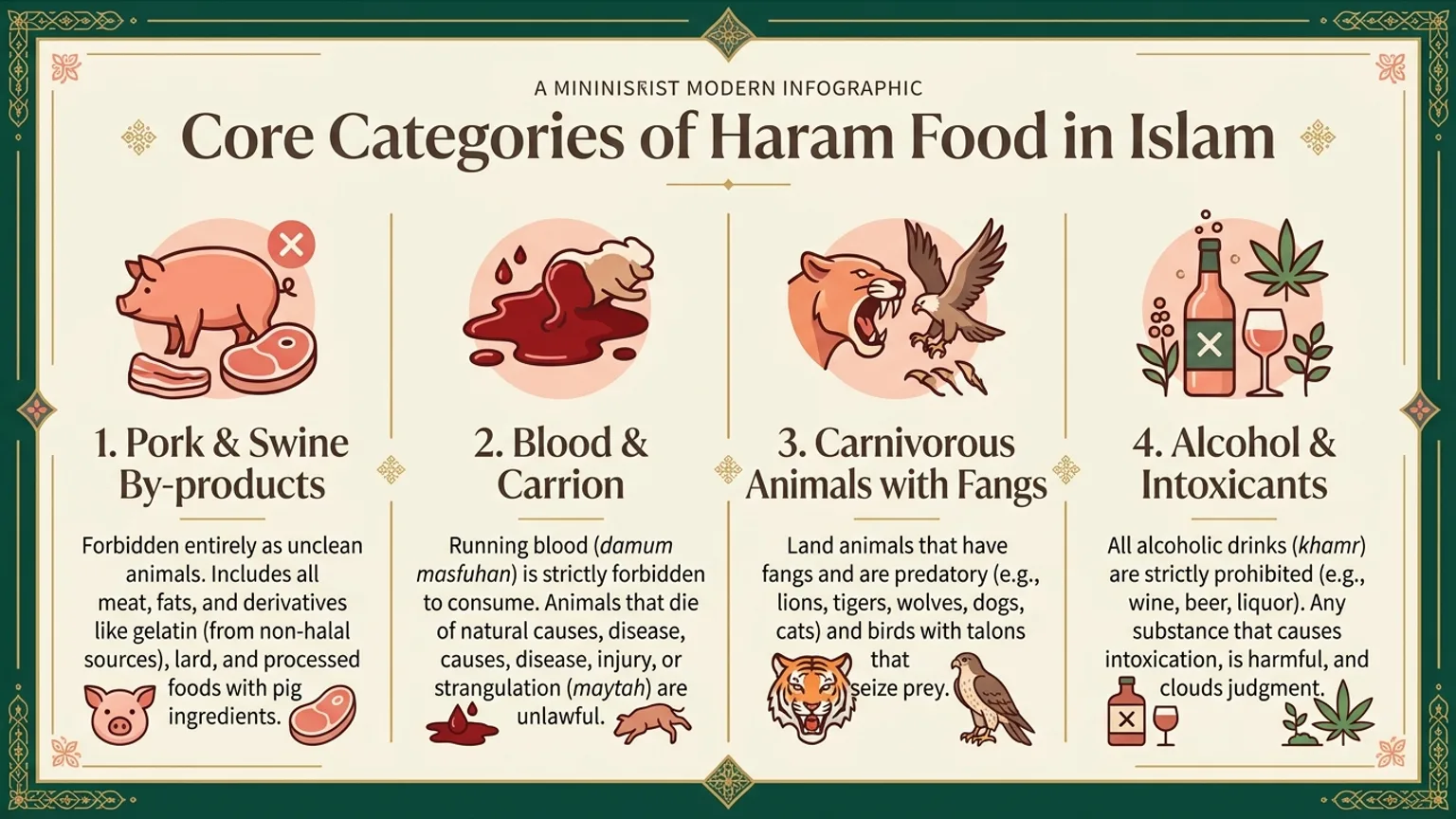
“Forbidden to you are carrion, blood, and swine; what is slaughtered in the name of any other than Allah; what is killed by strangling, beating, a fall, or by being gored to death; what is partly eaten by a predator unless you slaughter it; and what is sacrificed on altars.” (Surah Al-Ma’idah 5:3)
Allah also says, “Do not eat of what is not slaughtered in Allah’s Name. For that would certainly be [an act of] disobedience” (Surah Al-An’am 6:121). And He forbids intoxicants: “Intoxicants, gambling, idols, and drawing lots for decisions are all evil of Satan’s handiwork. So shun them so you may be successful” (Surah Al-Ma’idah 5:90).
What the Sunnah adds
The Prophet (peace be upon him) explained and added to these:
- “Allah’s Messenger prohibited the eating of all fanged beasts of prey, and all the birds having talons” (Sahih Muslim 1934).
- “Allah’s Messenger prohibited the eating of donkey’s meat” (Sahih al-Bukhari 5527). This refers to the domestic donkey.
- “Every intoxicant is Khamr and every intoxicant is forbidden” (Sahih Muslim 2003). This extends the ban from wine to anything that intoxicates.
- “Two kinds of dead meat and two kinds of blood have been permitted to us. The two kinds of dead meat are fish and locusts, and the two kinds of blood are the liver and spleen” (Sunan Ibn Majah 3314). These are the exceptions to carrion and blood.
The Prophet also “forbids to them what is impure” (Surah Al-A’raf 7:157). Scholars use this verse, al-khaba’ith, for things people naturally find repulsive, such as vermin and insects. Their application of it differs between schools.
Haram foods: the complete table
| Haram food | Evidence | Notes |
|---|---|---|
| Pork and all pig products | Quran 2:173, 5:3, 6:145 | Includes lard, bacon, ham, pork gelatin, pork enzymes. See is pork halal and is bacon halal |
| Carrion (animals that died without slaughter) | Quran 5:3 | Except fish and locusts |
| Flowing blood | Quran 5:3, 6:145 | Liver and spleen are permitted; small traces left in meat after draining are excused |
| Animals slaughtered in a name other than Allah’s | Quran 5:3 | Including sacrifices to idols |
| Animals killed by strangling, a blow, a fall or goring | Quran 5:3 | Unless slaughtered while still alive. The basis of the stunning debate |
| Animals partly eaten by a predator | Quran 5:3 | Unless slaughtered while still alive |
| Meat not slaughtered in Allah’s name | Quran 6:121 | Schools differ when it’s forgotten. See what is halal |
| Predators with fangs (lions, tigers, wolves, dogs, cats, bears) | Muslim 1934 | Agreed by the four schools (Maliki views are softer on some) |
| Birds of prey with talons (eagles, hawks, falcons, owls) | Muslim 1934 | |
| Domestic donkeys and mules | Bukhari 5527 | Wild donkeys (zebras) are treated differently; Shia scholars such as Sayyid Sistani rule donkey and mule meat makruh, not haram |
| Alcohol and all intoxicants | Quran 5:90; Muslim 2003 | Wine, beer, spirits, and drugs that intoxicate |
| Anything poisonous or harmful | Quran 2:195 | “Do not throw yourselves into destruction” |
Foods the schools disagree about
| Food | Hanafi | Shafi’i | Maliki | Hanbali | Ja’fari (Shia) |
|---|---|---|---|---|---|
| Prawns and shrimp | Debated | Halal | Halal | Halal | Halal |
| Crab, lobster, mussels, octopus | Not permitted | Halal | Halal | Halal (a few exceptions) | Not permitted |
| Horse | Makruh (Abu Hanifa) | Halal | Views differ | Halal | Halal (disliked) |
| Rabbit | Halal | Halal | Halal | Halal | Not permitted |
| Insects (other than locusts) | Not permitted | Not permitted | Some permitted | Not permitted | Not permitted |
| Carmine (E120, from insects) | Mostly not permitted | Mostly not permitted | Permitted | Mostly not permitted | Varies |
Where schools differ, follow the school or scholar you normally follow. Our specific guides go into each: lobster, octopus, horse meat, and carmine in Takis.
Hidden haram: ingredients to watch for
Most people never knowingly eat pork or drink wine. The real risk is in processed food, where haram ingredients hide under technical names.
| Ingredient | Where it’s found | Status |
|---|---|---|
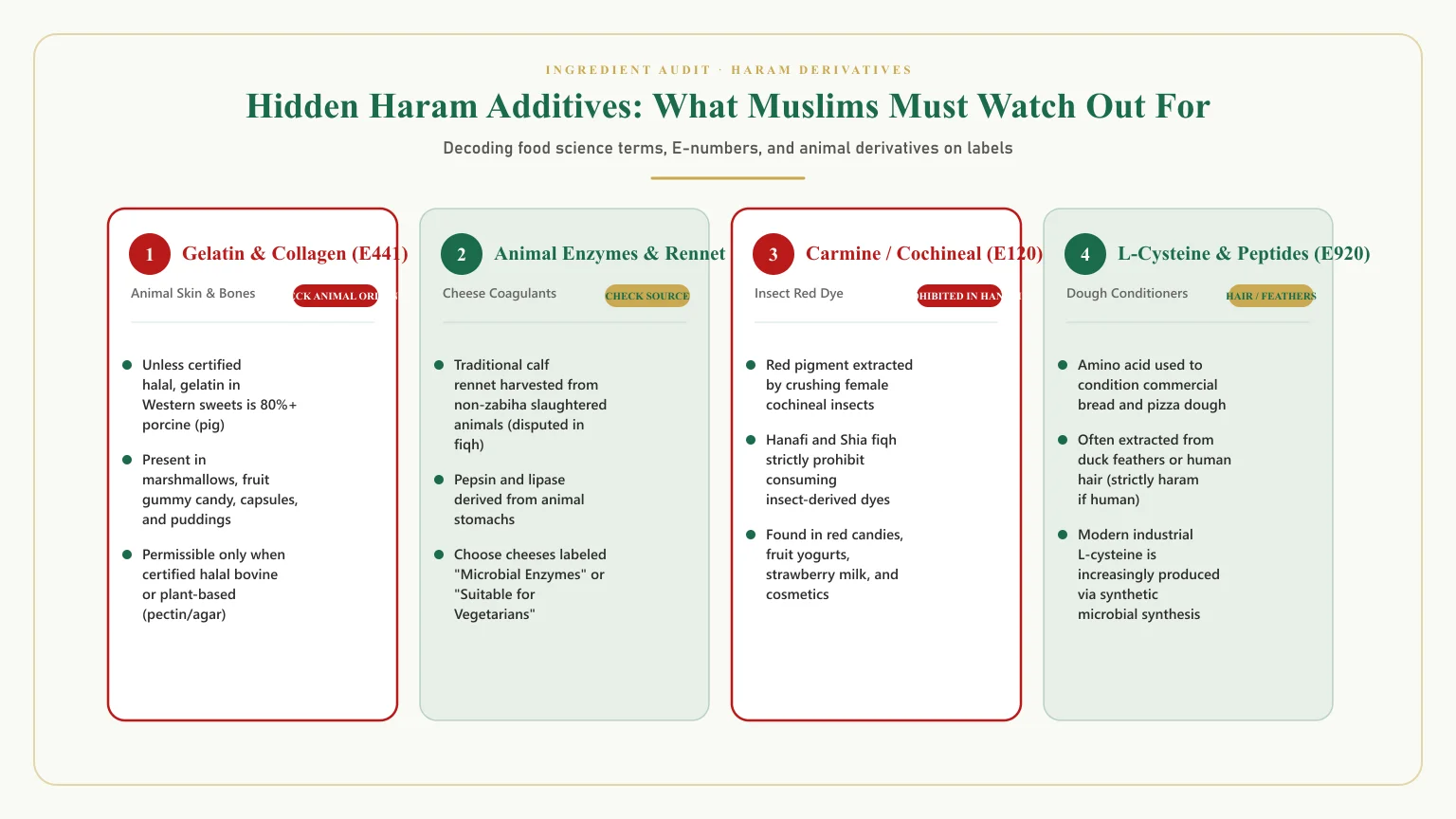
| Lard, pork fat | Pastry, biscuits, refried beans, some breads | Haram |
| Gelatin (E441) | Sweets, jelly, marshmallows, yoghurts, capsules | Haram if from pork; halal if from fish or halal beef. See is gelatin halal |
| Pepsin | Some cheeses, supplements | Haram if from pigs |
| Animal rennet | Traditional cheeses | Debated. See is cheese halal |
| Alcohol, wine, beer, spirits | Sauces, desserts, flavourings | Haram as an added ingredient; tiny solvent traces debated. See vanilla extract |
| Wine vinegar | Dressings, mustard | Halal for Hanafis and Shia; debated for Shafi’is and Hanbalis. See white wine vinegar |
| Carmine, cochineal (E120) | Red sweets, drinks, yoghurts | Debated between schools |
| L-cysteine (E920) | Some bread and baked goods | Doubtful unless made from plants or synthetically |
| Mono and diglycerides (E471) | Bread, ice cream, margarine | Doubtful unless marked vegetable or halal |
| Edible bone phosphate (E542) | Some supplements and foods | Doubtful: made from animal bones |
| Disodium inosinate (E631), guanylate (E627) | Crisps, noodles, stock cubes | Depends on source. See E631 |
| “Natural flavourings” | Almost everything | Usually fine; check meat flavours |
A vegetarian label rules out meat, gelatin and animal fats, but not alcohol. A vegan label also rules out milk derivatives, eggs and insect colours. A halal certificate from a trusted body covers all of it.
Doubtful things: mushbooh
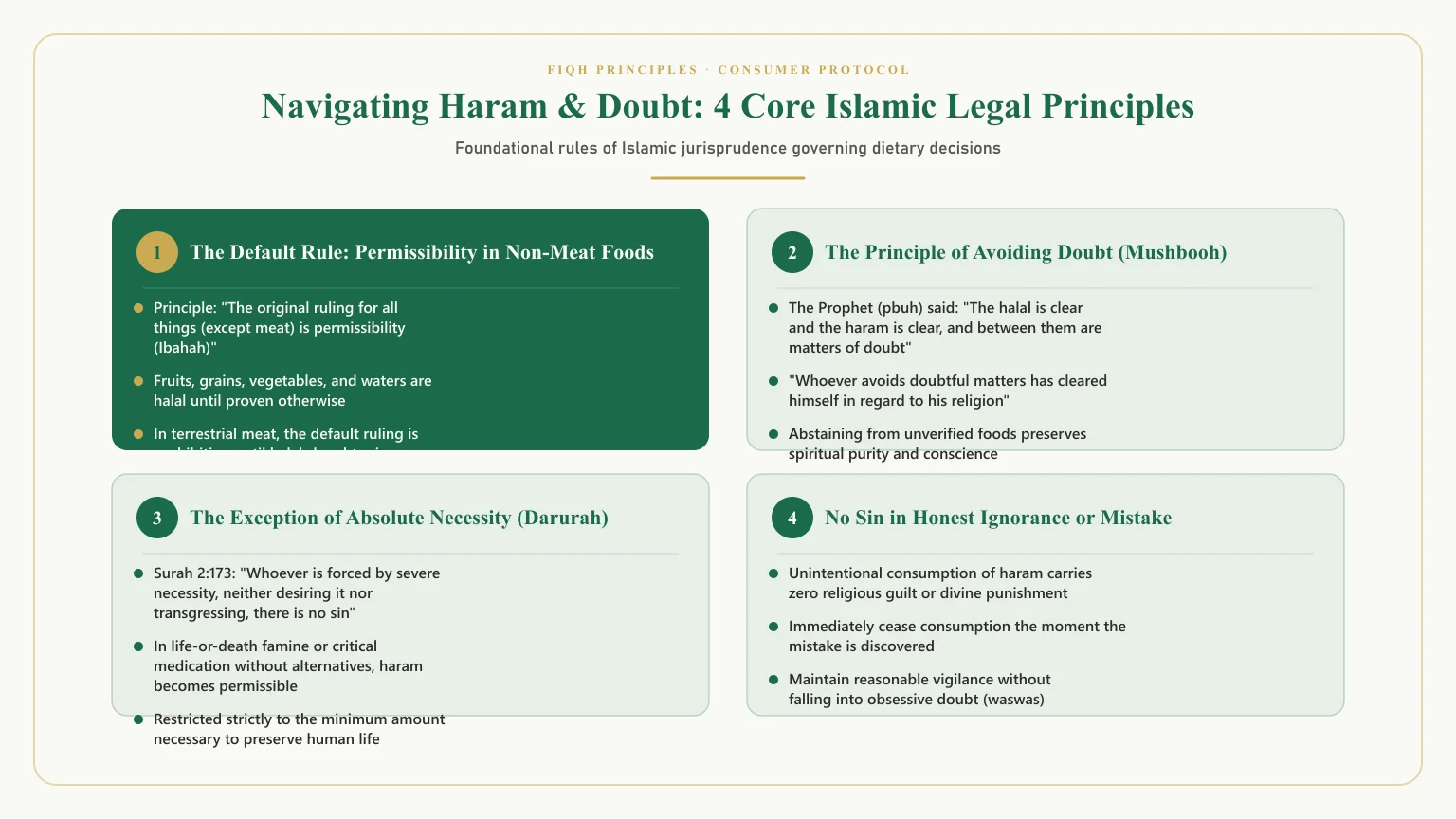
Between the clearly halal and the clearly haram is a grey area, called mushbooh (doubtful) or shubuhat. The Prophet (peace be upon him) said:
“Both legal and illegal things are evident but in between them there are doubtful (suspicious) things and most of the people have no knowledge about them. So whoever saves himself from these suspicious things saves his religion and his honor.” (Sahih al-Bukhari 52)
Imam al-Nawawi placed this hadith sixth in his famous Forty Hadith, and scholars have called it one of the hadith that the whole religion turns on. The Hanbali scholar Ibn Rajab, in his commentary Jami’ al-‘Ulum wa al-Hikam, explains that doubtful things are unclear to many people, not to everyone. Scholars who study them can often resolve the doubt. That’s exactly what halal research and certification do.
The Prophet also said, “Leave what makes you in doubt for what does not make you in doubt” (Jami at-Tirmidhi 2518).
Imam al-Ghazali, in the book on the lawful and unlawful in his Ihya’ ‘Ulum al-Din, describes levels of carefulness (wara’). The minimum is avoiding what’s clearly haram. Beyond that, people choose how far to avoid the doubtful. He also warns against the opposite error: obsessive suspicion of things that are clearly fine.
In practice:
- Genuine doubt (an unlabelled meat product, an E-number that could be pork): avoid it or check.
- Imagined doubt (bread, plain crisps, a vegetarian sweet): don’t create doubt where there isn’t any. Allah warns against forbidding “the good things which Allah has made lawful” (Surah Al-Ma’idah 5:87).
When haram becomes permitted: necessity
Islamic law allows exceptions for real necessity. Right after listing forbidden foods, Allah says that “if someone is compelled by necessity” and is “neither driven by desire nor exceeding immediate need”, “they will not be sinful. Surely Allah is All-Forgiving, Most Merciful” (Surah Al-Baqarah 2:173). Surah Al-Ma’idah 5:3 ends in the same way.
Scholars turned this into a legal maxim, recorded by Imam al-Suyuti in al-Ashbah wa al-Naza’ir: necessity makes forbidden things permissible, with a second rule that necessity is measured by its extent. So:
- A person facing death from hunger may eat haram food, but only enough to survive.
- Medicine with a haram ingredient may be permitted if there’s no halal alternative and a doctor advises it. Ask a scholar for your case.
- Inconvenience isn’t necessity. Being hungry on a trip with no halal restaurant nearby usually means eating vegetarian or fish, not eating haram meat.
Eating haram by mistake
Many people worry about this, and the answer is reassuring. Allah taught the believers to pray, “Our Lord! Do not punish us if we forget or make a mistake” (Surah Al-Baqarah 2:286). And the Prophet (peace be upon him) said:
“Allah has forgiven my nation for mistakes and forgetfulness, and what they are forced to do.” (Sunan Ibn Majah 2045)
If you ate something and later found out it contained pork or alcohol, there is no sin on you. What to do:
- Stop as soon as you know.
- Rinse your mouth if you’re still eating.
- You don’t need to make yourself sick. Scholars generally don’t require it.
- Learn for next time. Note the brand or ingredient so it doesn’t happen again.
Sin comes from knowingly choosing haram, or from careless disregard, not from honest error.
The same applies if someone served you food and told you it was halal when it wasn’t. The sin of the lie is on them, not on you. And if you ate at a restaurant that later turned out to use non halal meat, there’s nothing you need to make up. Just choose more carefully in future, perhaps by asking to see the kind of certificate the restaurant holds.
Haram beyond food
Haram isn’t only about what goes in your mouth. It covers how you earn, spend and deal with others. For a halal food website, the most relevant area is money, because food bought with haram money is itself a problem.
Haram earnings
The Prophet (peace be upon him) said, “Allah is Good and He therefore, accepts only that which is good” (Sahih Muslim 1015). In the same hadith, he described a traveller raising his hands in prayer whose “diet is unlawful, his drink is unlawful, and his clothes are unlawful”, and asked how such a prayer could be answered. Allah says, “Do not consume one another’s wealth unjustly” (Surah Al-Baqarah 2:188).
Main haram financial practices
| Practice | Evidence | What it covers |
|---|---|---|
| Interest (riba) | Quran 2:275: “Allah has permitted trading and forbidden interest”; Muslim 1598 | Taking or paying interest on loans, most conventional savings interest |
| Gambling (maysir) | Quran 5:90 | Betting, lotteries, casino games |
| Cheating and fraud | Muslim 102: “He who deceives is not of me” | Hiding defects, false labels, short measures |
| Theft, bribery and unjust gain | Quran 2:188 | Taking wealth by false means |
| Trading in haram goods | Scholarly consensus | Selling alcohol, pork, drugs |
The Prophet (peace be upon him) “cursed the accepter of interest and its payer, and one who records it, and the two witnesses, and he said: They are all equal” (Sahih Muslim 1598). That’s why Islamic banks use trade, leasing and profit sharing instead of interest.
The cheating hadith has a direct link to food. The Prophet put his hand into a pile of grain and found it wet underneath, hidden from buyers. He said, “He who deceives is not of me” (Sahih Muslim 102). A food business that labels non halal meat as halal, or shows a supplier certificate as if it covered the whole kitchen, is doing the same thing.
Other areas of haram
Islam also forbids many acts that aren’t about food or money, including:
- Associating partners with Allah (shirk), which the Quran calls the greatest sin
- Murder
- Adultery
- Lying and false testimony
- Backbiting and slander
- Disrespecting parents
- Oppression
These are beyond the scope of a food guide. For rulings on them, consult a qualified scholar.
Common myths about haram
A few beliefs come up again and again. Here’s what the evidence says.
| Myth | The reality |
|---|---|
| “Anything without a halal logo is haram” | No. Food is halal by default. Logos matter for meat and processed food where you can’t see the source |
| “Vegetarian means halal” | Almost. Vegetarian rules out meat and gelatin, but not alcohol, such as wine in a sauce |
| “Fish must be slaughtered” | No. Fish is halal without slaughter, in every school |
| “Cooking makes pork halal” | No. Cooking doesn’t change pork. Alcohol partly burns off, but adding it is still the problem |
| “A Muslim owner means the food is halal” | Not necessarily. Ask where the meat comes from |
| “Makruh means haram” | No. Makruh is disliked, not forbidden, except the Hanafi makruh tahrimi, which is close to haram |
| “Eating haram by mistake is a sin” | No. Honest mistakes are forgiven |
For drinks, see our guides to kombucha and spirit vinegar, where trace alcohol is explained. For flavour enhancers, see E621.
Why does Allah make things haram?
Muslims avoid haram first because Allah commanded it. Pork is haram because the Quran says so, in several verses, not because of any scientific finding.
Some people point to health reasons, like parasites in undercooked pork or the harm of alcohol, and the Quran itself notes that intoxicants bring “great sin” alongside “some benefit” (Surah Al-Baqarah 2:219). But the ruling doesn’t depend on those reasons. If pork were perfectly safe, it would still be haram.
Scholars describe the wisdom of the halal and haram system in terms of protecting five things: religion, life, intellect, family and property. Intoxicants harm the intellect, riba and fraud harm property, and so on.
Understanding the wisdom helps, but obedience comes first. The Companions didn’t ask for a health study before pouring away their wine when the prohibition came. They simply stopped, and that attitude of trust is at the heart of how Muslims approach halal and haram.
Final thoughts
Haram means forbidden, and only Allah can make something haram. In food, the list is short: pork, blood, carrion, intoxicants, meat not slaughtered in Allah’s name, predators, birds of prey and donkeys. Today’s real challenge is hidden ingredients, which is what our guides and halal certification help you check.
Where there’s genuine doubt, leave it. Where there’s none, don’t invent it.
If you slip by mistake, there’s no sin. In necessity, the rules bend to preserve life. And haram reaches beyond food to how you earn and deal with others.
For the permitted side of the picture, read our guide to what is halal. If you have a question about a food we haven’t covered, ask us through our Contact page.
Frequently Asked Questions
Sources & references26
We checked every claim in this guide against these sources.
- - title: "Quran 2:173 (forbidden foods and necessity)"quran.com
- Quran 5:3 (the full list of forbidden meat)quran.com
- Quran 5:90 (intoxicants and gambling)quran.com
- Quran 6:121 (not slaughtered in Allah's name)quran.com
- Quran 16:116 (do not falsely declare halal and haram)quran.com
- Quran 2:275 (trade permitted, interest forbidden)quran.com
- Quran 2:188 (consuming wealth unjustly)quran.com
- Quran 2:286 (do not punish us if we forget)quran.com
- Quran 7:157 (permits what is lawful, forbids what is impure)quran.com
- Quran 2:195 (do not throw yourselves into destruction)quran.com
- Quran 2:219 (intoxicants: great sin and some benefit)quran.com
- Quran 6:145 (blood poured forth, swine)quran.com
- Quran 5:87 (do not forbid good things)quran.com
- Sahih Muslim 1934 (fanged beasts and birds with talons)sunnah.com
- Sahih al-Bukhari 5527 (donkey meat)sunnah.com
- Sahih Muslim 2003 (every intoxicant is khamr)sunnah.com
- Sunan Ibn Majah 3314 (fish and locusts, liver and spleen)sunnah.com
- Sahih al-Bukhari 52 (doubtful matters)sunnah.com
- Jami at-Tirmidhi 2518 (leave what makes you in doubt)sunnah.com
- Jami at-Tirmidhi 1726 (what Allah was silent about)sunnah.com
- Sahih Muslim 1598 (the curse on interest)sunnah.com
- Sahih Muslim 102 (he who deceives is not of me)sunnah.com
- Sahih Muslim 1015 (Allah accepts only what is good)sunnah.com
- Sunan Ibn Majah 2045 (mistakes and forgetfulness forgiven)sunnah.com
- Britannica: Haram (sacred place)britannica.com
- IslamQA 10887: What is haram and what is halal?islamqa.info