What Is Makruh? Meaning, Types and Examples in Islam
Makruh is an Arabic word meaning disliked. In Islamic law it's an act the Shariah discourages without forbidding it: you're rewarded for avoiding it, but not punished for doing it. The Hanafi school splits it in two. Makruh tahrimi is close to haram and sinful, while makruh tanzihi is a mild dislike and not a sin.
⚠️ DisputedIn this guide13 sections
- Makruh at a glance
- What does makruh mean?
- Where makruh sits among the five rulings
- Makruh tahrimi and makruh tanzihi: the Hanafi split
- Is makruh a sin?
- How scholars decide something is makruh
- Makruh foods and eating habits, by school
- Makruh beyond food
- When a makruh ruling changes: the smoking example
- Makruh vs haram vs mashbooh, and common mistakes
- Final thoughts
- Frequently asked questions
- Related guides
Makruh is an Arabic word meaning disliked. In Islamic law, it describes something the Shariah discourages without forbidding it outright. If you avoid a makruh act, you’re rewarded. If you do it, you aren’t punished, although making a habit of it is blameworthy.
That simple definition has one important exception. The Hanafi school splits makruh into two levels, and the stronger level, makruh tahrimi, is treated as sinful. So when a Hanafi scholar calls something “makruh”, it can mean something much closer to haram than when a Shafi’i scholar uses the same word. This guide explains both uses, how scholars decide something is makruh, and the makruh foods and eating habits you’ll meet on our other guides.
Makruh at a glance
| Question | Short answer |
|---|---|
| What does makruh mean? | Disliked; discouraged but not forbidden |
| Is makruh a sin? | No, except Hanafi makruh tahrimi |
| Is there reward for avoiding it? | Yes |
| Hanafi types | Makruh tahrimi (close to haram, sinful) and makruh tanzihi (mild dislike, not sinful) |
| Food examples | Horse meat (Abu Hanifa, Shia scholars), prawns (some Hanafis), donkey meat (Shia scholars) |
| Eating habit examples | Eating with the left hand, blowing into a drink, drinking while standing, raw garlic before the mosque |
| Makruh vs mashbooh | Makruh has a known ruling; mashbooh means the ruling or the facts are unclear |
What does makruh mean?
Makruh comes from the Arabic root k-r-h, which means to dislike or find something hateful. The noun karaha means dislike, and makruh means “that which is disliked”. In the language of fiqh, it’s an act the Lawgiver has asked us to leave, but not in a definitive, binding way. IslamQA, drawing on the usul work Sharh al-Waraqat, defines it as “that which the Lawgiver asks us not to do, but not in a definitive manner.”
The word itself is older and broader than the technical term. In the Quran, after a list of grave sins including killing and adultery, Allah says, “The violation of any of these ˹commandments˺ is detestable to your Lord” (Surah Al-Isra 17:38). The Arabic word translated as “detestable” is makruha. There it clearly describes forbidden acts, not mild dislikes.
Ibn al-Qayyim pointed out in I’lam al-Muwaqqi’in that the early imams sometimes said “I dislike this” when they meant it was forbidden, out of caution about declaring things haram. Later students, reading the word in its technical sense, sometimes treated those statements as a mild dislike. That’s worth remembering when you read a classical quotation: “makruh” in an old text doesn’t always mean what it means in a modern fiqh manual.
Where makruh sits among the five rulings
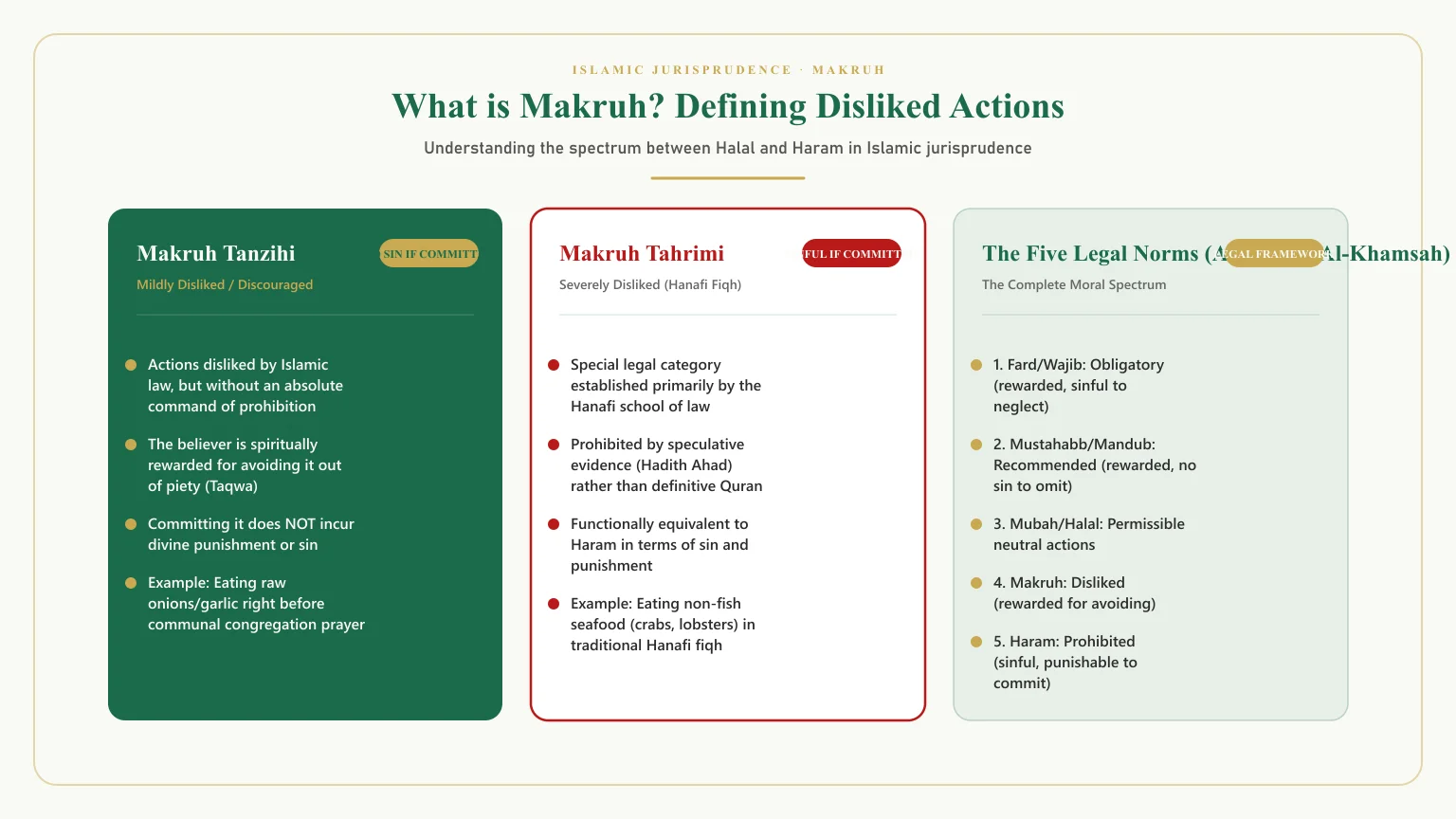
Islamic law places every action in one of five rulings, known as al-ahkam al-khamsa:
| Ruling | Arabic | Doing it | Leaving it | Example |
|---|---|---|---|---|
| Obligatory | Fard / Wajib | Rewarded | Sinful | The five daily prayers |
| Recommended | Mustahabb / Mandub / Sunnah | Rewarded | No sin | Saying Bismillah before eating |
| Permitted | Mubah | Neutral | Neutral | Eating bread |
| Disliked | Makruh | No sin (except makruh tahrimi) | Rewarded | Eating raw garlic before going to the mosque |
| Forbidden | Haram | Sinful | Rewarded | Eating pork |
Makruh sits between permitted and forbidden. Everything that isn’t haram is technically halal, so makruh things are halal in the broad sense. That’s why you’ll see phrases like “halal but makruh” on food questions. For more on the two ends of the scale, see what is halal and what is haram.
The middle categories protect Muslims from two opposite mistakes. One is treating everything disliked as forbidden. Allah warns, “Do not falsely declare with your tongues, ‘This is lawful, and that is unlawful,’ ˹only˺ fabricating lies against Allah” (Surah An-Nahl 16:116), and, “O believers! Do not forbid the good things which Allah has made lawful for you” (Surah Al-Ma’idah 5:87).
The other mistake is treating makruh as meaningless. Scholars teach that a Muslim who wants to please Allah leaves what He dislikes, even when there’s no punishment attached.
Makruh tahrimi and makruh tanzihi: the Hanafi split
The Hanafi school divides makruh into two levels, and knowing the difference changes how you read a Hanafi fatwa.
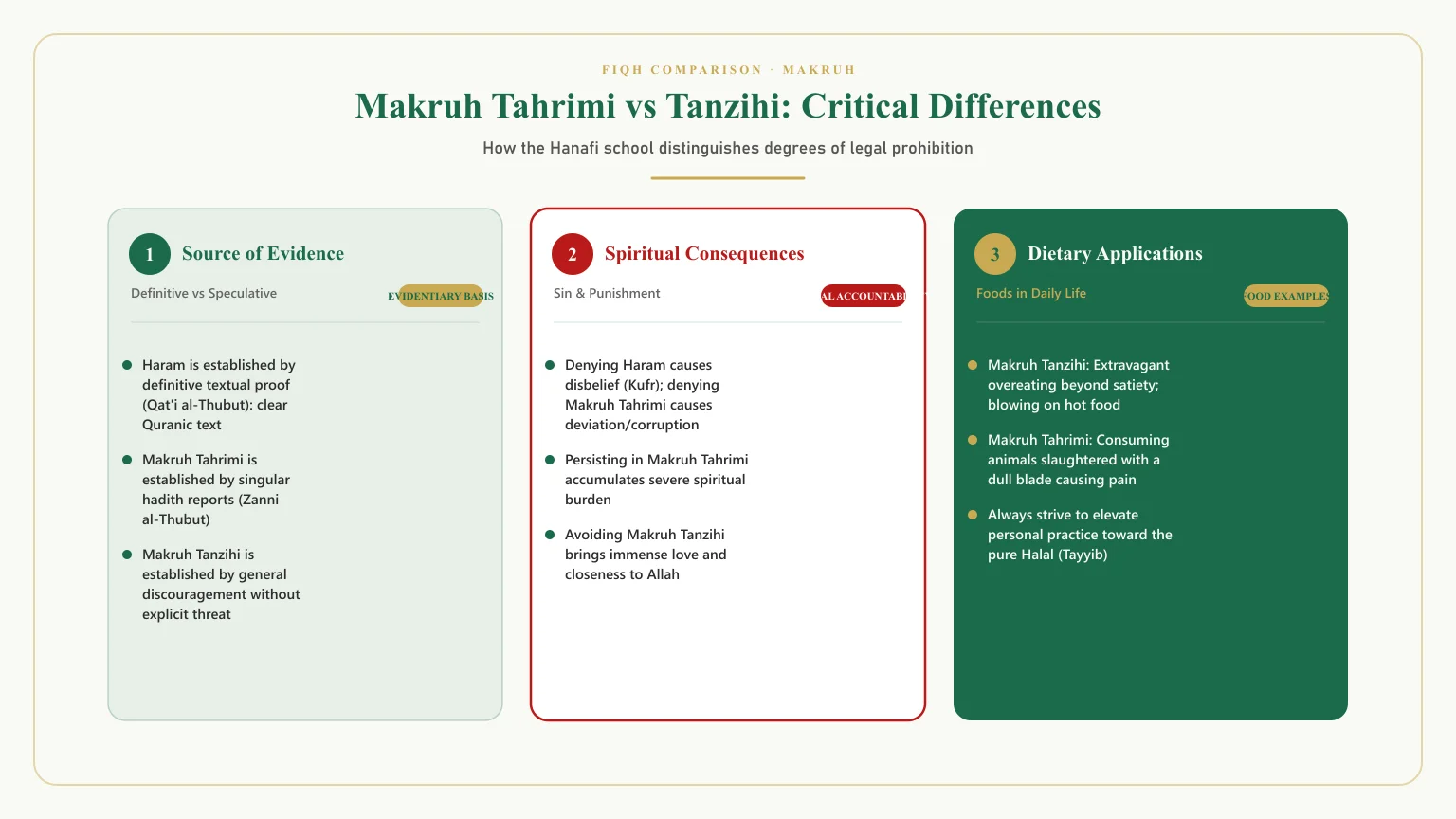
Makruh tahrimi (prohibitively disliked). Mufti Muhammad ibn Adam of Darul Iftaa, Leicester, citing Shaykh Abd al-Fattah Abu Ghudda, defines it as “a command for abstinence that has been established by speculative proof (dalil dhanni). It is closer to the unlawful (haram).” He adds that failing to abstain “necessitates a sin and punishment in the hereafter.”
Makruh tanzihi (mildly disliked). The same source defines it as “an act that is detested in Shariah, without the promise of punishment for the one who carries it out.” It’s “closer to the lawful (mubah) than the unlawful (haram).”
What separates makruh tahrimi from haram is the strength of the evidence, not how serious the act feels. Shaykh Faraz A. Khan of SeekersGuidance explains that haram is established by definitive texts, while makruh tahrimi is established by texts that aren’t fully definitive.
Deliberately declaring something haram to be permissible can amount to rejecting the religion; the same isn’t true of makruh tahrimi. In practice, though, Hanafis are told to avoid both. Shaykh Faraz lists examples of makruh tahrimi such as taking bribes, getting tattooed, and praying while needing the toilet.
How the other schools use the word
The Shafi’i, Maliki and Hanbali schools don’t split makruh in the same way. For them, makruh generally means the milder level: rewarded if left, not punished if done. Where evidence for a prohibition is strong enough, they simply call the act haram. Later Shafi’i scholars also use khilaf al-awla, “contrary to what is better”, for acts that are even milder than makruh.
Shia jurists use makruh in the mild sense too. Sayyid Sistani’s Islamic Laws has long lists of makruh acts, especially around eating, which we cover below. That’s why the same act can be “haram” in one school and “makruh” in another: often the schools agree the act is discouraged, but disagree about how strong the evidence is.
Is makruh a sin?
For most scholars, no. A makruh act, in the Shafi’i, Maliki and Hanbali sense, and Hanafi makruh tanzihi, carries no sin. The person who leaves it for Allah’s sake is rewarded, and the person who does it isn’t punished.
The exception is Hanafi makruh tahrimi, which is sinful. If you follow the Hanafi school and a scholar tells you something is “makruh”, it’s worth asking which kind they mean.
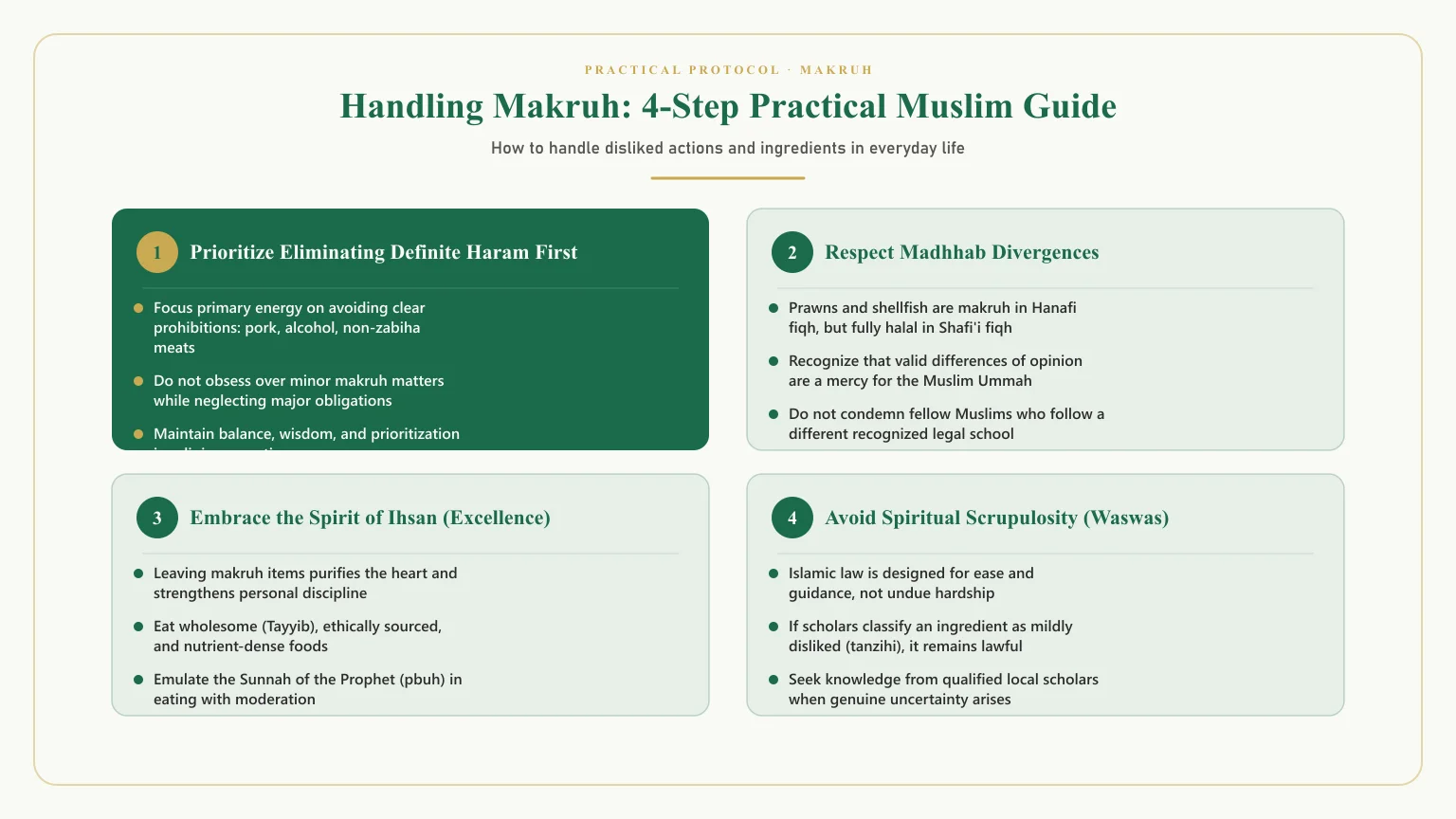
There are two further points scholars stress. First, habit matters. Regularly and carelessly doing what Allah dislikes is blameworthy, even if each single act isn’t a sin. Scholars have long said that a person who is relaxed about makruh things drifts more easily towards haram ones.
Second, the Prophet (peace be upon him) taught caution around unclear matters:
“So whoever saves himself from these suspicious things saves his religion and his honor.” (Sahih al-Bukhari 52)
Makruh isn’t the same as doubtful, but the spirit is similar. A Muslim aiming for taqwa (God consciousness) doesn’t ask only “Is this a sin?” but also “Does Allah love this?”
How scholars decide something is makruh
Scholars don’t label things makruh by personal taste. They look for particular signs in the evidence. Three common ones are below.
1. A prohibition with a sign that it isn’t binding. The clearest example is garlic. The Prophet (peace be upon him) said, “Whoever eats garlic or onion should keep away from our mosque” (Sahih al-Bukhari 855). When people concluded that garlic had been forbidden, he said:
“O people, I cannot forbid (the use of a thing) which Allah has made lawful, but (this garlic) is a plant the odour of which is repugnant to me.” (Sahih Muslim 565)
So garlic is halal, but eating it raw before going to the mosque is disliked, because its smell troubles other worshippers.
2. A prohibition alongside the Prophet’s own practice. Anas reported that the Prophet “disapproved the drinking of water while standing” (Sahih Muslim 2024). But Ali drank standing and said, “I saw the Prophet (peace be upon him) doing (drinking water) as you have seen me doing now” (Sahih al-Bukhari 5615). Imam al-Nawawi reconciled the two reports: drinking while standing is makruh tanzihi, and the Prophet did it to show that it’s permitted.
3. Personal dislike isn’t the same as a ruling. When the Prophet (peace be upon him) was served a roasted mastigure (dabb, a desert lizard), he didn’t eat it. Khalid ibn al-Walid asked if it was unlawful, and he said, “No, but this is not found in the land of my people, so I dislike it” (Sahih al-Bukhari 5537).
Ibn Umar reported him saying, “I do not eat mastigure, but I do not prohibit its eating” (Sahih al-Bukhari 5536). The Shafi’i and Hanbali schools therefore permit it, while Imam Abu Hanifa judged it makruh based on other narrations.
Scholars also check the authenticity of a report. A famous example is “Of all the lawful acts the most detestable to Allah is divorce” (Sunan Abi Dawud 2178), which al-Albani graded weak (da’if). Its meaning is widely accepted, but it isn’t a strong proof on its own.
Makruh foods and eating habits, by school
Most of our food guides give a clear halal or haram answer. The ones below are where “makruh” comes up.
| Food or habit | Hanafi | Shafi’i | Maliki | Hanbali | Ja’fari (Shia) |
|---|---|---|---|---|---|
| Horse meat | Abu Hanifa: makruh tanzihi; his two students: permitted | Halal | Disliked in the main view | Halal | Makruh |
| Donkey and mule meat | Haram | Haram | Haram | Haram | Makruh (Sistani) |
| Prawns and shrimp | Debated: permitted, makruh or not permitted | Halal | Halal | Halal | Halal |
| Mastigure (dabb) | Makruh (Abu Hanifa) | Halal | Halal | Halal | Not permitted |
| Animal fed mostly on filth (jallalah) | Makruh until fed clean feed | Makruh | Views differ | Some say haram | Haram until cleansed |
| Raw garlic or onion before the mosque | Makruh | Makruh | Makruh | Makruh | Makruh |
For the details behind each food, see is horse meat halal, are prawns halal, is shrimp halal and, for jallalah, is chicken halal.
Eating and drinking habits that are makruh
These come from the Sunnah and apply across the schools, with small differences in how strongly each is disliked:
- Eating or drinking with the left hand. “When any one of you intends to eat (meal), he should eat with his right hand” (Sahih Muslim 2020). Most scholars class using the left hand without a reason as makruh; some say it’s haram.
- Blowing or breathing into a drink. “The Messenger of Allah (peace be upon him) prohibited breathing in the vessel, or blowing into it” (Jami at-Tirmidhi 1888).
- Drinking while standing, as explained above.
- Eating when already full. Sayyid Sistani’s Islamic Laws lists eating without hunger and eating to the point of being overfull among makruh acts, along with blowing on hot food.
Makruh beyond food
Makruh isn’t only about food. It covers worship, speech, money and daily manners. The Prophet (peace be upon him) said:
“Allah has hated for you three things: 1. Vain talks, (useless talk) that you talk too much or about others. 2. Wasting of wealth (by extravagance) 3. And asking too many questions (in disputed religious matters) or asking others for something (except in great need).” (Sahih al-Bukhari 1477)
Other examples scholars commonly give include:
- In prayer: looking around, fidgeting, or praying while needing the toilet (makruh tahrimi for Hanafis).
- In wudu: using far more water than needed.
- In daily life: the Prophet (peace be upon him) “disliked to sleep before the `Isha’ prayer and to talk after it” (Sahih al-Bukhari 568), unless there’s a need.
The exact ruling on each varies between schools, so check with a scholar of your own school for anything specific.
When a makruh ruling changes: the smoking example
A ruling can move between makruh and haram when the facts change, even though the principles stay the same. Smoking is the best known example.
Many older fatwas classed smoking as makruh, because its harm wasn’t well understood. As medical evidence grew, many councils moved to haram, based on the principle that Islam forbids harming yourself and others. Singapore’s Islamic council, MUIS, is a clear case. Its 1993 fatwa said smoking was generally makruh. In 2006, its Fatwa Committee ruled that “smoking is prohibited because the harm on the smoker and the people around him is clear and definite.”
The same logic applies to food. When an ingredient turns out to come from a haram source, a product that seemed merely doubtful becomes haram. And when a harmful effect is proven, something once called makruh can become forbidden.
Makruh vs haram vs mashbooh, and common mistakes
These three terms are often mixed up. Here’s how they differ:
| Makruh | Haram | Mashbooh (doubtful) | |
|---|---|---|---|
| Meaning | Disliked | Forbidden | Unclear |
| Is the ruling known? | Yes | Yes | No: either the ruling or the facts are unclear |
| Sin if done? | No (except Hanafi makruh tahrimi) | Yes | Not certain, but best avoided |
| Reward for leaving it? | Yes | Yes | Yes, for caution |
| Food example | Horse meat for Abu Hanifa | Pork | Gelatin from an unknown source |
In short, makruh is a known ruling that the act is disliked. Mashbooh describes uncertainty, often about a product’s ingredients. Our product guides use “doubtful” for the second case, such as sweets with unnamed gelatin.
Common mistakes about makruh
| Myth | The reality |
|---|---|
| “Makruh means haram.” | No. Makruh is disliked, not forbidden, except Hanafi makruh tahrimi, which is close to haram. |
| “Makruh doesn’t matter.” | It does. Leaving it is rewarded, and a habit of doing it is blameworthy. |
| “If the Prophet didn’t eat something, it’s makruh.” | Not always. He didn’t eat mastigure, but he said, “I do not prohibit its eating.” |
| “All schools mean the same thing by makruh.” | No. A Hanafi “makruh” can mean sinful; a Shafi’i “makruh” doesn’t. |
| “Anything I find distasteful is makruh.” | No. Rulings come from the evidence, not personal preference. |
Final thoughts
Makruh means disliked: something the Shariah asks you to leave without forbidding it. Avoiding it earns reward, and doing it isn’t a sin, except for the Hanafi category of makruh tahrimi, which is close to haram. Scholars decide what’s makruh from the evidence, such as the hadith on garlic and drinking while standing, not from personal taste.
In food, makruh comes up with horse meat, prawns for some Hanafis, donkey meat for Shia scholars, and eating habits like using the left hand or blowing into a drink. If your school calls something makruh, ask whether it’s the mild kind or the strong kind, and lean towards leaving it when you can. If you have a question we haven’t covered, ask us through our Contact page.
Frequently Asked Questions
Sources & references19
We checked every claim in this guide against these sources.
- - title: "Quran 16:116 (do not falsely declare lawful and unlawful)"quran.com
- Quran 5:87 (do not forbid the good things)quran.com
- Quran 17:38 (detestable to your Lord)quran.com
- Sahih Muslim 565 (garlic: I cannot forbid what Allah made lawful)sunnah.com
- Sahih al-Bukhari 855 (garlic or onion and the mosque)sunnah.com
- Sahih al-Bukhari 1477 (Allah has hated for you three things)sunnah.com
- Sahih al-Bukhari 52 (doubtful matters)sunnah.com
- Sahih Muslim 2024 (drinking while standing)sunnah.com
- Sahih al-Bukhari 5615 (Ali drinks standing)sunnah.com
- Sahih Muslim 2020 (eat with the right hand)sunnah.com
- Jami at-Tirmidhi 1888 (blowing into the vessel)sunnah.com
- Sahih al-Bukhari 5536 and 5537 (the mastigure)sunnah.com
- Sahih al-Bukhari 568 (sleeping before Isha, talking after it)sunnah.com
- Sunan Abi Dawud 2178 (divorce, graded weak)sunnah.com
- Darul Iftaa (Mufti Muhammad ibn Adam): What does makruh mean in the Hanafi madhhabdaruliftaa.com
- SeekersGuidance (Shaykh Faraz A. Khan): Haram vs makruh tahrimanseekersguidance.org
- IslamQA 9084: Difference between makruh and haramislamqa.info
- Sayyid Sistani, Islamic Laws: Rules of things allowed to eat and drinkal-islam.org
- MUIS: Fatwa on smokingmuis.gov.sg