E631 Halal or Haram? Disodium Inosinate Sources Explained
E631 (disodium inosinate) is halal when it's made by fermenting plant sugars or starch, or from fish. It's haram if it's made from pork, and doubtful if it's from meat that wasn't halal slaughtered. The label doesn't show the source, so look for a halal logo, a vegetarian or vegan mark, or a statement from the maker.
ℹ️ Halal with ConditionsIn this guide8 sections
E631 is disodium inosinate, a flavour enhancer found in crisps, instant noodles and stock cubes. Whether it’s halal depends entirely on where it came from. It can be made in three ways:
- Fermenting plant sugars or starch. This is halal.
- Extracting it from fish. This is halal.
- Extracting it from meat, including pork. Pork-derived E631 is haram, and E631 from meat that wasn’t halal slaughtered isn’t accepted by certifiers.
The label only says “E631” or “disodium inosinate”, so you can’t tell which from the ingredient list. That’s why it’s often called mushbooh (doubtful). The good news is that most E631 today is made by fermentation, and there are simple ways to check. In Pakistan, SANHA has confirmed that the E631 in Lay’s is made from tapioca starch.
Quick answer by source
| Source of E631 | Halal? | Why |
|---|---|---|
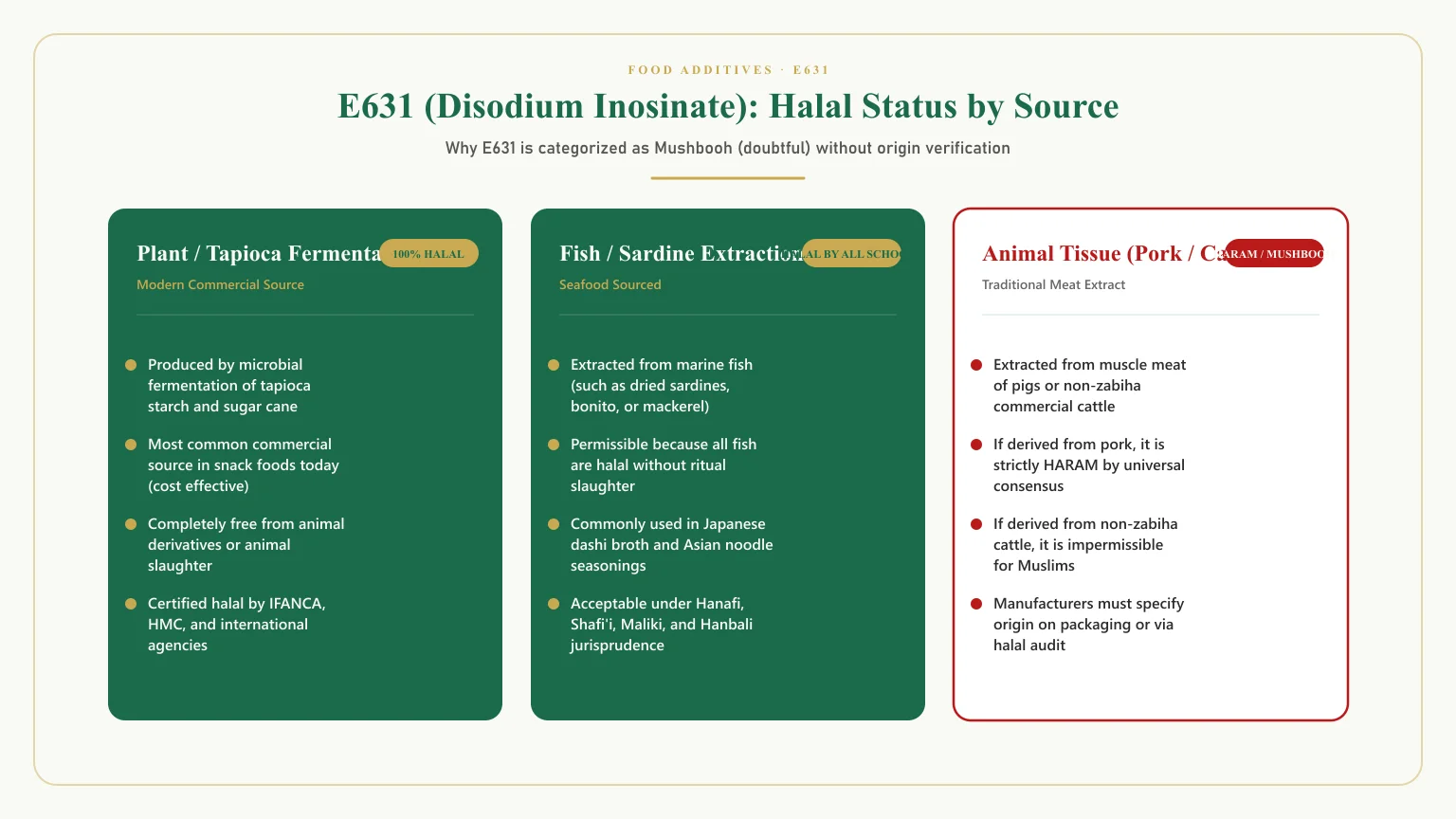
| Fermentation of sugar or starch (e.g. tapioca, sugarcane) | Halal | Plant based, no animal involved |
| Fish (e.g. sardines, tuna) | Halal | Fish is halal in every school |
| Beef or chicken, not halal slaughtered | Not accepted by certifiers | Same issue as non zabiha meat |
| Beef or chicken, halal slaughtered | Halal | Rarely used |
| Pork | Haram | Pork is forbidden; most scholars reject istihalah here |
| Unknown (no logo or label claim) | Mushbooh (doubtful) | Check using the steps below |
What E631 is and how it’s made
Disodium inosinate is the sodium salt of inosinic acid, a compound found naturally in meat and fish. It’s what gives a well-made broth or dried fish its deep savoury taste.
On its own, E631 is expensive, so it’s almost always used with E621 (MSG). Together they boost savoury flavour far more than either alone. It’s also often paired with E627 (disodium guanylate), and the mix of E627 and E631 has its own number: E635 (disodium 5’-ribonucleotides). When you see any of these, the same halal question applies.
You’ll find E631, E627 or E635 in:
- Flavoured crisps and corn snacks
- Instant noodles and their seasoning sachets
- Stock cubes, gravy granules and soup powders
- Seasoning mixes and spice blends
- Savoury biscuits and crackers
- Ready meals and processed meats
Three ways to make E631
There are three ways to make E631, and manufacturers don’t have to say which one they used.
- Fermentation. Bacteria are fed sugar or starch, such as tapioca, and produce inosinic acid, which is then purified.
- Extraction from fish. Inosinic acid is extracted from fish such as sardines.
- Extraction from meat. Inosinic acid is extracted from animal muscle. In some countries that has included pork.
So how common is each? Sources disagree.
The UK’s Vegetarian Society has said that production from meat or fish is more widespread. The US Vegetarian Resource Group reports that the three leading manufacturers all say they use fermentation. On balance, most E631 made today is thought to be fermented. You still can’t assume that for any particular product.
What Islamic law says about each source
Fermented E631: halal
Anything made from plant sugars by fermentation, with no haram ingredient, is halal. The general rule of the Quran applies: “eat from whatever is on earth that is lawful and good” (Surah Al-Baqarah 2:168).
Fish-derived E631: halal in every school
Allah says, “Lawful to you is game from the sea and its food” (Surah Al-Ma’idah 5:96). The Prophet (peace be upon him) said of the sea, “Its water is pure, and its dead are lawful” (Jami at-Tirmidhi 69). He also said:
“Two kinds of dead meat and two kinds of blood have been permitted to us. The two kinds of dead meat are fish and locusts.” (Sunan Ibn Majah 3314)
Fish doesn’t need slaughter, so E631 from sardines or tuna is halal for Hanafi, Shafi’i, Maliki, Hanbali and Shia Muslims alike. Imam al-Nawawi, the Shafi’i jurist, sets out in al-Majmu’ that fish is lawful however it died. The Hanafi school limits sea food to fish, but sardines and tuna are fish, so there’s no debate here. For other seafood, see our guide to prawns.
Pork-derived E631: haram for almost everyone
The Quran forbids “the flesh of swine” (Surah Al-Ma’idah 5:3). The question some raise is istihalah: has the pork changed so completely during processing that it’s a new substance? Scholars have debated this for gelatin:
- The Islamic Organization for Medical Sciences held that some pork derivatives are transformed enough to be permissible.
- The Islamic Fiqh Council in Jeddah and most halal certifiers reject this. Dr Wafeeq ash-Sharqawi argued that if a lab can still identify the animal source, the change is only partial.
Most scholars and every major certifier treat pork-derived additives as haram. Our guide to whether gelatin is halal covers the debate in full.
Meat-derived E631 that isn’t pork
If E631 comes from beef or chicken, the question becomes whether the animal was halal slaughtered. Certifiers don’t accept derivatives from non zabiha animals. A few scholars take a wider view of meat from Christian and Jewish countries, but that’s rarely relevant here, because meat-derived E631 is uncommon and you can’t know the country of the animal.
Why E631 is called mushbooh, and how to check a label
The Prophet (peace be upon him) said:
“Both legal and illegal things are evident but in between them there are doubtful (suspicious) things and most of the people have no knowledge about them. So whoever saves himself from these suspicious things saves his religion and his honor.” (Sahih al-Bukhari 52)
E631 is a textbook example. The same E-number can come from halal or haram sources, and nothing on the label tells you which.
That’s why halal apps and certifiers list it as mushbooh, not as haram. SANHA, the South African and Pakistani certifier, put it plainly: E631 is “not necessarily Haraam”. It depends on the source, and the doubt can usually be cleared.
How to check if the E631 in a product is halal
| What you see on the pack | What it tells you | Verdict |
|---|---|---|
| A halal logo from a recognised certifier | The certifier has checked the E631 source | Halal |
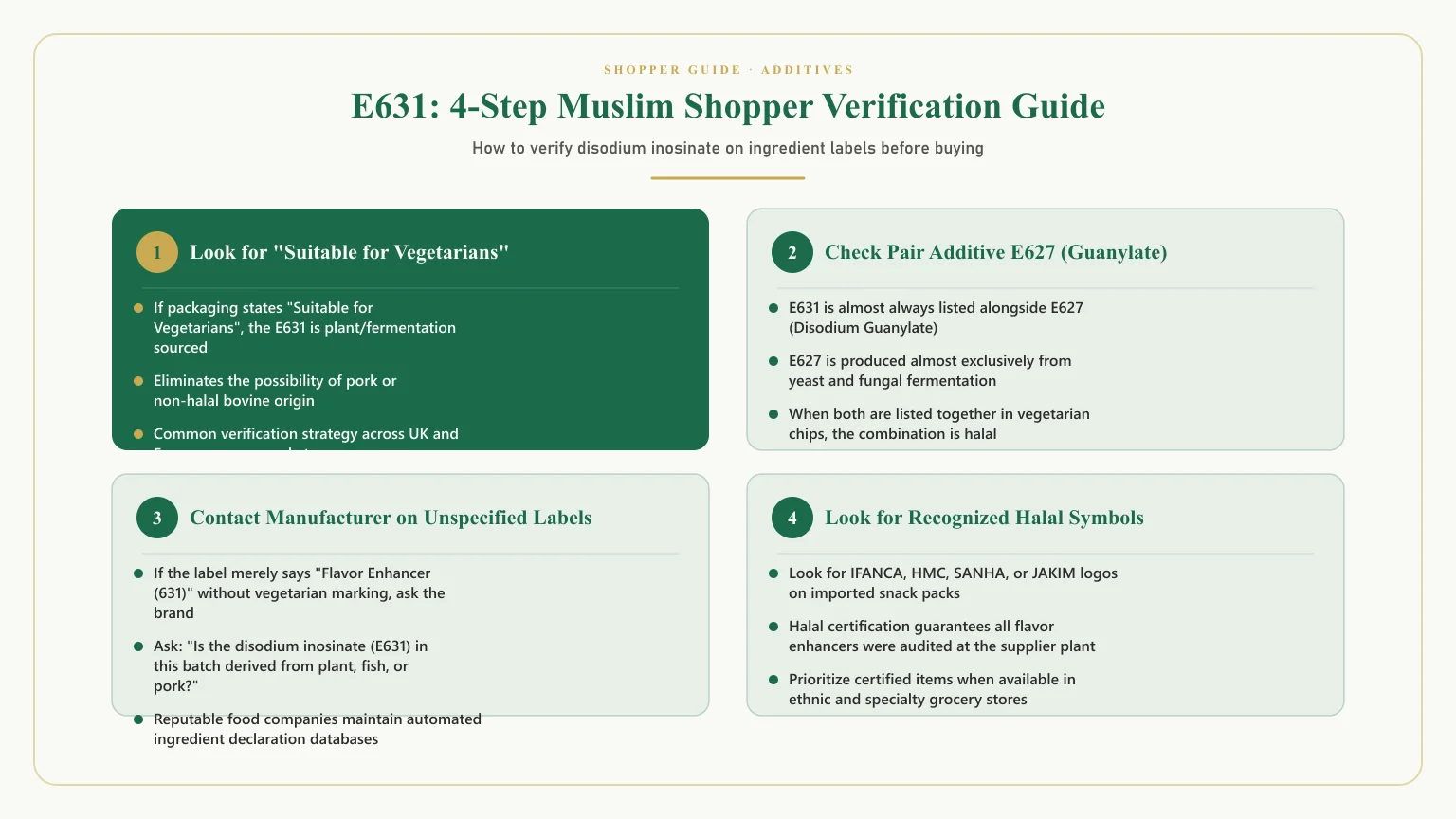
| “Suitable for vegetarians” or a Vegetarian Society logo | No meat or fish derived E631 | Halal |
| “Vegan” | Plant or fermentation derived only | Halal |
| “Contains fish” or fish allergen warning | May be fish derived | Halal (fish) |
| No logo, no vegetarian claim, meat flavour | Could be any source | Doubtful. Contact the maker |
| Pork or bacon flavour, no vegetarian claim | Higher chance of animal source | Avoid |
If there’s no mark, email or message the manufacturer and ask: “What is the source of the E631 (and E627) in this product?”
Is E631 in Lay’s halal?
This is the question we get most, especially from Pakistan. In January 2022, a viral video claimed the E631 in Lay’s chips came from pork fat.
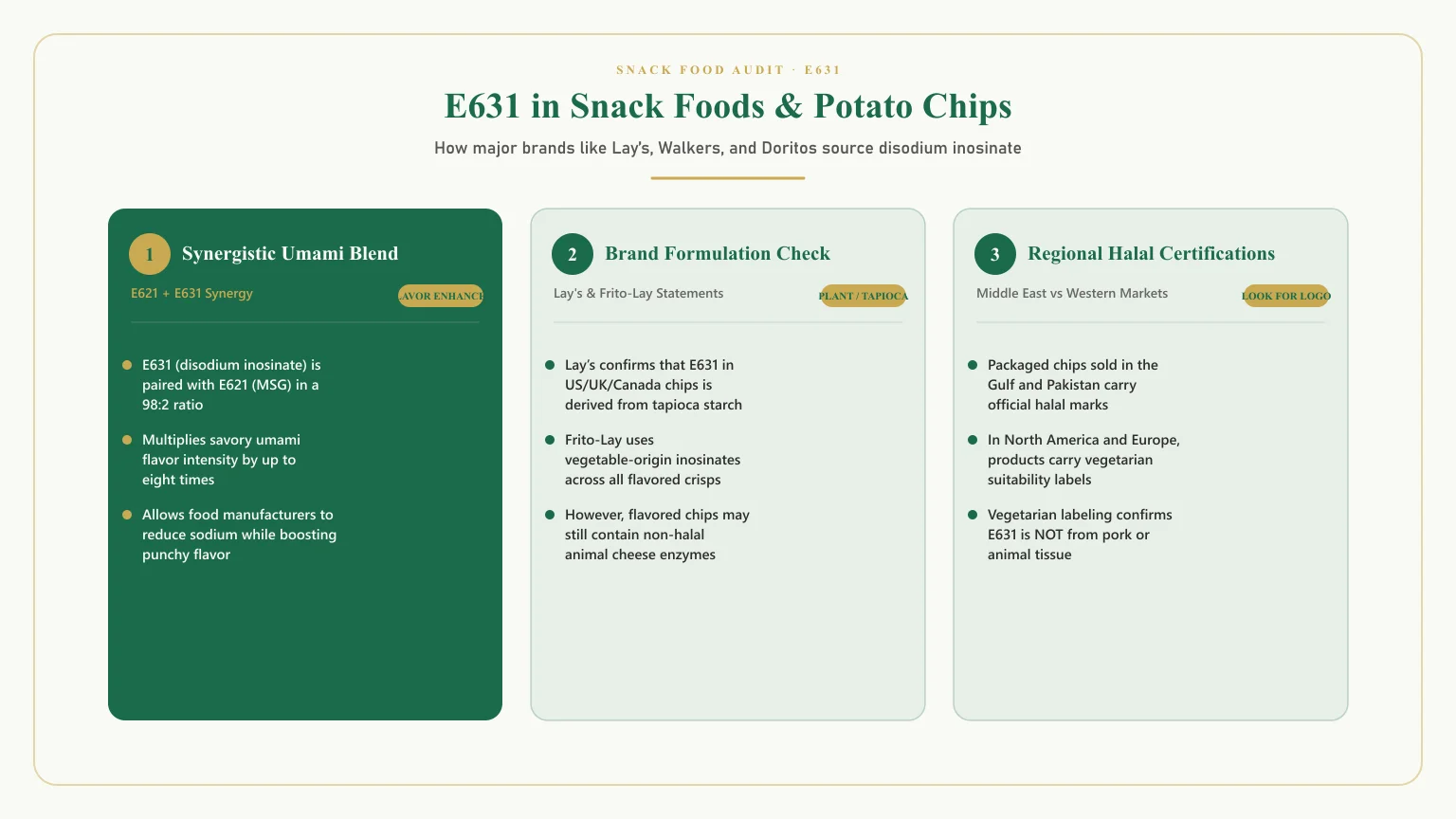
PepsiCo Pakistan and SANHA Pakistan both responded. SANHA confirmed that “the E631 food additive used as a flavour enhancer in Lay’s snacks product is derived from plant extract of tapioca starch”, and Lay’s said its products are “100% Halaal, certified by SANHA”. Soch Fact Check rated the viral claim false. It’s a good example of how a scary claim about an E-number spreads faster than the answer, and why it’s worth checking with the certifier before sharing.
That answer covers Lay’s made in Pakistan. In other countries, Lay’s (Walkers in the UK) uses different factories and recipes. Check the pack for a halal logo or vegetarian mark, and see our guides to Doritos and Cheetos, which are also made by PepsiCo.
E631 and E621 together
People often ask about E621 and E631 together, because they appear side by side on labels. They’re different:
- E621 (MSG) is made by fermenting plant sugars and is halal for most scholars. Read our guide to E621.
- E631 may come from plants, fish or meat, so it needs checking.
Seeing E621 on a label is no cause for worry. Seeing E631, E627 or E635 is a reason to look for a halal or vegetarian mark.
Final thoughts
E631 isn’t haram by default. Made by fermentation or from fish, it’s halal in every school.
Made from pork, it’s haram, and from non halal meat it’s not accepted by certifiers. Most E631 today is fermented, but you can’t assume that for any one product. A halal logo, a vegetarian or vegan label, or a manufacturer’s statement settles it, as SANHA’s confirmation did for Lay’s Pakistan.
If a brand tells you the source of its E631, share it through our Contact page and we’ll add it to this guide.
Frequently Asked Questions
Sources & references10
We checked every claim in this guide against these sources.
- - title: "Quran 5:3 (prohibited foods)"quran.com
- Quran 5:96 (game of the sea)quran.com
- Quran 2:168 (eat what is lawful and good)quran.com
- Jami at-Tirmidhi 69 (the sea: its dead are lawful)sunnah.com
- Sunan Ibn Majah 3314 (two kinds of dead meat: fish and locusts)sunnah.com
- Sahih al-Bukhari 52 (doubtful matters)sunnah.com
- Soch Fact Check: Lay's snacks sold in Pakistan do not contain pork (Feb 2022)sochfactcheck.com
- SANHA on X: E631 is not necessarily haraamx.com
- Wikipedia: Disodium inosinateen.wikipedia.org
- HalalCodeCheck: E627 and E631 in crisps, noodles and snackshalalcodecheck.com